About Me
The Manifesto
The Further Adventures of Hiatus
This hiatus just got REAL
Meh declared cromulent
The usual post-election vocab lesson
Contest FAIL
A National Punctuation Day Contest
No one will ever pick up on this hyperbole
A spirited defense of good grammar
Good Stuff: 8/29/08
Montreal: phonetics, purists, and even some terror...
Back to Main


Bartleby
Common Errors in English
Netvibes RSS Reader
Online Etymology Dictionary
Research and Documentation
The Phrase Finder
The Trouble with EM 'n EN
A Capital Idea
Arrant Pedantry
Blogslot
Bradshaw of the Future
Bremer Sprachblog
Dictionary Evangelist
Double-Tongued Dictionary
Editrix
English, Jack
Fritinancy
Futility Closet - Language
Language Hat
Language Log
Mighty Red Pen
Motivated Grammar
Omniglot
OUPblog - Lexicography
Style & Substance
The Editor's Desk
The Engine Room
Tongue-Tied
Tenser, said the Tensor
Watch Yer Language
Word Spy
You Don't Say
Dan's Webpage

Monday, November 24, 2008 3:09 PM
Ben Zimmer has an omnibus post on meh up over at Word Routes, and I don't really have much to add to it. He even caught the miscitation of the 2001 Simpsons episode "Hungry, Hungry Homer" instead of the 1995 episode "Lisa's Wedding."
(Note to Collins Dictionaries: Snpp.com is your friend.)
I did want to point out, however, that Jeffrey Rowland of Overcompensating — no stranger to word rage — has posted a comic about meh. Check it out.
(I especially like how he's wearing a "The" shirt instead of the expected "Teh" shirt — for sale here, explained here. It's prescriptivism with style!)
DNC beers and legislative acronyms
Wednesday, July 30, 2008 12:42 PM
There's also mention of a Political Ale from Rock Bottom. Lame. Personally, I think that would have been better as PoliticAle, in the manner of our local Surly CynicAle.

(Speaking of, I can't find anything on RNC beers for us Minnesotans. Town Hall will probably do something though. And Flat Earth will continue making Black Helicopter, as always. Oh, beer names.)
(The government's strange approach to beer labels is also worth pondering. There are rumors that this somehow explains why there's no Black Helicopter in bottles.)
Related: apparently the Tomnibus has stalled, which is completely fine with those of us who only liked it because it had the best nickname of any legislation ever. (Alternative candidates welcome.)
I've just discovered, however, that the Tomnibus just happened to contain the MOTHERS Act. Let's look at section 1 of the MOTHERS Act:
This Act may be cited as the 'Mom's Opportunity to Access Health, Education, Research, and Support for Postpartum Depression Act' or the 'MOTHERS Act'.
As several political commentators have already noted, there's no consistent rule you can apply that would give you MOTHERS from that name: the most logical acronym would have been MOAHERSPD.
Over at Reason, Jacob Sullum has a post on poorly contrived legislative acronyms. It concludes with this excellent observation:
Still, at least their staffers made a half-assed attempt at a memorably demagogic name. Not so Rep. James Sensenbrenner (R-Wis.), whose REAL ID Act includes a completely bogus "acronym" that does not stand for anything except his desire to trick people into believing he came up with a ridiculously contrived name that generates an evocative acronym. REAL is a fake.
The NYT doesn't all-caps acronyms longer than four letters, so it managed to sidestep the whole MOTHERS issue... but I see that it went with Real ID in numerous articles, when of course the official name is written REAL ID.
A strange case of eschewing accuracy for the sake of... accuracy.
I think Surly CynicAle is like the best beer name ever.
Then there's the Protecting Records, Optimizing Treatment, and Easing Communication through Healthcare Technology Act of 2008.... of course known as: the ‘PRO(TECH)T Act of 2008.
The IT geeks will be the death of us all.


Nice-nice
Wednesday, June 25, 2008 12:45 PM
I love that making nice-nice. I'm a sucker for this sort of reduplication(?) in English, whether it's meant to clarify (as in "he drives a car-car") or — as is presumably the case here — merely there for emphasis (like my friend who says "multiple multiple times").
And then there's that famous Sidney Morgenbesser story:
In the 1950's, the British philosopher J.L. Austin came to Columbia to present a paper about the close analysis of language. He'd just explained that, although two negatives make a positive, nowhere is it the case that two positives make a negative, when from the audience a familiar nasal voice muttered a dismissive, "Yeah, yeah."
(Also humorous but completely unrelated: I just learned that the heart of rock and roll is not Topeka, but rather still beatin'. Mondegreen ho!)
Thanks for your comment on prescriptivism, Dan. As for this reduplication issue, I've considered this idea with friends after a phonology class we once had. English doesn't seem too keen on them, but there is one that we, at least, believed to be an example of reduplication:
"Do you like him, or do you like-like him?"
As I'm sure you know, many African languages use reduplication even as a derivational morpheme, so it's extreme in their use, unlike in ours.
In the South, where "Coke" can mean any type of soda, I often had to order a "Coke-Coke" to make it clear that what I wanted was a Coca-Cola in particular.
P.S.: I was in college before I realized "I Saw Mommy Kissing Santa Claus" wasn't about an affair. Really.
Maybe one person makes nice, and two people together make nice-nice.
Sounds a bit childish to me (but then so does 'makes nice').
An episode of "Curb Your Enthusiasm" offers this advice: You have to make the nice.
Thought you might enjoy this piece on reduplication:
http://www.good.is/?p=14517

[sic]
Wednesday, May 28, 2008 10:49 AM
Chuck Norris noticed your correct spelling, made an error in it, and dared you to say some shit.
Oh.my.goodness. Funniest thing I've read all week.
My favorite prescriptivist is a talking dinosaur
Tuesday, May 13, 2008 3:27 PM
Loosely categorized! Whoo!
Words we hate comics
It's a disaster!
You heard me!
Men stereotypically leave the toilet seat up!
There are other words than "bitches"! Daaamn!
It is not a generic intensifier!
Words we love comics
For instance: the word "awful" (really bad) and the word "offal" (butchered entrails)!
Sorry, other word classes! I have a NEW girlfriend now!
Prescriptivism comics
So dumb!
Well, yeah!
And guys I wasn't even trying that hard!
FOR EXAMPLE: T-Rex is a pretty sweet dude because he's always so friggin' awesome!
RESOLUTION ONE: eat less chickens!
Man! I'll never have kids at this rate!
Okay! Our first letter comes from Jenn!
Cowboy hat dude got DECIMATED!
Guys! I am not alone in this!
(Pleonasm is the use of redundant, unnecessary words to express an idea!)
Etymology comics
However, this is not the case!
I also left a big tip, so as not to appear NIGGARDLY!
They MOVED?
A HISTORY OF HYSTERIA
First: snake oil salesmen!
Linguistics-ish comics
This source says: DEFINITELY YES!
It's the coolest!
Labels: comics, etymology, geekery, grammar politics, spelling
"However, this is not the case" seems to imply that "man" is derived from Latin "humanus."
"Maybe ADJECTIVES wouldn't force us to have such conversations!" hehe he
Oh, how I love Dinosaur Comics. And I've realized that I never finished going through all the archives.
Also, I really like this Scrabble comic.
Hah. When I was in college "playing Scrabble" was often employed as a euphemism for "having sex."
nenu shudda shaakaahaarini - Telugu for "I am a pure vegetarian" heheh
Thanks for posting this. I forgot how much I like Dinosaur Comics.
Internet famous is the best famous
Tuesday, April 29, 2008 7:28 AM
The business first became Internet famous a decade ago, but has proved remarkably durable, with sales climbing to around $4.5 million last year.
It's new to the NYT, but Internet famous has been around for a while now. Last year Time had an article on an "Internet Famous" course offered through the Parsons New School for Design.
Years ago I coined (or re-coined; it's so hard to tell) the phrase Internet true, but it didn't go anywhere. I blame truthiness.
Geeking out with the U.S. Board on Geographic Names
Tuesday, April 22, 2008 12:20 AM
The Board is responsible by law for standardizing geographic names throughout the Federal Government, and discourages name changes unless necessary. Further, the Board states that, "changing a name merely to correct or re-establish historical usage is not in and of itself a reason to change a name."
That last sentence really makes things interesting. More BGN geekery:
New name proposals
The Apostrophe Problem
Trivia roundup
Argh. I hate the BGN. Their disdain for diacritics and the impossibility of recovering many originals thanks to their wacky transliteration systems is infuriating. I know they have a hard job, but they could show a little respect for the languages they deal with...
BGN Geekery: New name proposals
Monday, April 21, 2008 11:46 PM
This proposal is to change officially the name of Squaw Peak, the highest point inthe Phoenix Mountains, to Piestewa Peak. The change, submitted by the Governor of Arizona, is intended to eliminate a name considered by many to be derogatory, and also to honor U.S. Army Pfc. Lori Piestewa (b.1979), a Hopi Indian woman who died in the Iraqi conflict on March 23, 2003. Pfc. Piestewa is believed to be the first American Indian woman killed in combat.
For some states — I think it was Maine and Colorado — the proposal summary indicated that the renaming was mandated by a recent state law.
Since the government (in theory) won't change a name just to match the historical name or even to correct a misspelling, each renaming is accompanied by a lengthy proposal summary explaining the history of the old name and the reasoning behind the proposed change. These summaries were often quite charming.
Here are some of my favorite bits from the most recent quarterly review list:
This proposal, to name a 0.6 km (0.4 mi) long unnamed perennial spring-fed stream in Mobile County Turpentine Branch, would recall the early 1900's local history of turpentiners.
This proposal is to make official the name Sven Slab for a 91 m (300 ft) wide, 61m (200 ft) high cliff wall in the McDowell Sonoran Preserve, at the north end of the McDowell Mountains. According to the proponent, the name is widely used within the hiking and rock climbing community; the name came into use because Sven power saws were used to cut a trail to the base of the wall.
This proposal is to make official the Dena'ina name Taq' Nust'in Mountain for a 722 m (2,370 ft) summit in Lake and Peninsula Borough, just west of the Newhalen River and approximately 16 km (10 mi) northwest of the village of Iliamna. The proponent, a Professor of Linguistics Emeritus at the University of Alaska Fairbanks, reports the name is of Dena'ina origin and means "the one that extends across the timbered lowlands."
More recent research conducted by an archivist with the Colorado Mountain Club reveals that the 1878 Wheeler Survey referred to the "unnamed" peak by the descriptive name Frustum Peak. The word "frustum" refers to "a pyramid with the top chopped off," which the author notes could refer to Kit Carson Mountain but more likely to Humboldt Peak.
The proponent reports the name Corn Church Creek was chosen because the stream lies near St. John-Hill United Church of Christ (built in the mid-18th century and long known as the "Hill Church"); the church's roof, which projected over the sides, was used not only for storm protection but also for hanging seed corn to be dried. Many of the area's early German settlers referred to the church
as "Die Welshkorn Kerche" or "Corn Church."
Although the name Saline Branch Drainage Ditch has appeared on USGS topographic maps since 1957, the proponents report that the name is misleading and cumbersome and should be changed to West Salt Fork. They suggest the use of "Drainage Ditch" is particularly objectionable because the feature is predominantly a natural one, following the original course of the stream over most of its length, having been only straightened and deepened in a few places to facilitate drainage. They also believe the name "Saline" causes people to question the salinity and therefore the safety of the water for both recreational and drinking purposes.
The BGN seems to do a great job of contacting all interested parties before going ahead with a name change, but in many cases not everyone responds. Several of the proposal summaries contain the following (fantastic!) boilerplate: "No response was received, which is presumed to indicate a lack of an opinion on the issue."
For my other BGN posts, click here.
BGN Geekery: The Apostrophe Problem
11:32 PM
The U.S. Board on Geographic Names FAQ defends this decision at length. I still disagree with them, but their response is so interesting that I've excerpted it in its entirety here:
Since its inception in 1890, the U.S. Board on Geographic Names has discouraged the use of the possessive form — the genitive apostrophe and the "s". The possessive form using an "s" is allowed, but the apostrophe is almost always removed. The Board's archives contain no indication of the reason for this policy.
However, there are many names in the GNIS database that do carry the genitive apostrophe, because the Board chooses not to apply its policies to some types of features. Although the legal authority of the Board includes all named entities except Federal Buildings, certain categories — broadly determined to be "administrative" — are best left to the organization that administers them. Examples include schools, churches, cemeteries, hospitals, airports, shopping centers, etc. The Board promulgates the names, but leaves issues such as the use of the genitive or possessive apostrophe to the data owners.
Myths attempting to explain the policy include the idea that the apostrophe looks too much like a rock in water when printed on a map, and is therefore a hazard, or that in the days of "stick-up type" for maps, the apostrophe would become lost and create confusion. The probable explanation is that the Board does not want to show possession for natural features because, "ownership of a feature is not in and of itself a reason to name a feature or change its name."
Since 1890, only five Board decisions have allowed the genitive apostrophe for natural features. These are: Martha's Vineyard (1933) after an extensive local campaign; Ike's Point in New Jersey (1944) because "it would be unrecognizable otherwise"; John E's Pond in Rhode Island (1963) because otherwise it would be confused as John S Pond (note the lack of the use of a period, which is also discouraged); and Carlos Elmer's Joshua View (1995 at the specific request of the Arizona State Board on Geographic and Historic Names because, "otherwise three apparently given names in succession would dilute the meaning," that is, Joshua refers to a stand of trees. Clark's Mountain in Oregon (2002) was approved at the request of the Oregon Board to correspond with the personal references of Lewis and Clark.
For my other BGN posts, click here.
Labels: geekery, naming, punctuation
I've always wondered about the aversion to apostrophes. My parents recently lived in a town called Scottsbluff, which is named after a nearby bluff named after a man named Scott.
Not only is the apostrophe missing, but so is the space, which makes me want to say it with primary stress on the first syllable and no stress on the second, when in fact it's pronounced with secondary stress on the first and primary stress on the second.
BGN Geekery: Trivia roundup
10:56 PM
Contrary to popular belief, only 34 states have a community named Springfield; however, Riverside appears in 46 different states, with "only Alaska, Hawaii, Louisiana, and Oklahoma not having a community so named."
The 3,141 counties and county equivalents in the 50 States (and D.C.) are categorized as follows:
3,007 entities named "County"
16 Boroughs in Alaska
11 Census Areas in Alaska (for areas not organized into Boroughs by the State)
64 Parishes in Louisiana
42 Independent Cities (1 in Maryland, 1 in Missouri, 1 in Nevada, and the remainder in Virginia)
1 District - the Federal District or District of Columbia.
("What are the only two U.S. states without counties?" would be a good trivia question. Likewise, "What are the four states officially known as commonwealths?")
If you count hyphens, then Winchester-on-the-Severn, in Maryland, has the longest official community name in the U.S. Another Maryland community takes second place: Linstead-on-the-Severn, with 22 characters.
For communities without hyphens, it's a tie between the 17-letter Mooselookmeguntic, in Maine, and Kleinfeltersville, in Pennsylvania. Elsewhere in the U.S., Chickasawhatchee, Chancellorsville, and Eichelbergertown are all one letter short of the record.
The longest name, period, in their database is University of Rhode Island Coastal Institute on Narragansett Bay Conference and Visitor Center, at 94 characters. But they count spaces.
For my other BGN posts, click here.
Cluster and Mother
Tuesday, April 15, 2008 12:36 PM
Urban Dictionary has these clippings covered.
Pause to note that these aren't merely interrupted swears, like the mother- in the new Die Hard trailer or the holy- (for holy s***) that you see sometimes in movies or Homer Simpson's epic f- in "Who Shot Mr. Burns." You can use mother and cluster prettymuch anywhere in a sentence without adding an extra pause afterwards. (Disclaimer: Our Bold Hero is not a linguist.)
No, these are abbreviations of swear words, just like F, that ubiquitous signpost for f***.
(I suppose that suck, as in you suck or that sucks, is also similar, but those phrases leave considerably more up to the imagination. Donkeys are sometimes involved! The expression this blows works the same way — goats! — although it supposedly does not have a vulgar origin.)
In some ways mother and cluster are like minced oaths (Jebus, sugar, frak, etc.), which generally derive their meaning from their resemblance to an existing profanity. However, the connection here is stronger, because mother and cluster are also the building blocks of their dirty cousins. In mothertrucker, you've got a minced oath, but in mother it's just been chopped.
Then there's this item about "clustered nuns":
http://grammatically.blogspot.com/2008/04/hail-mary-full-of-grapes.html
I suppose the abbess would be a "clustered mother."
Why is it that when some nuns are left in darkness, they will seek out the light? Why is it that when nuns are stored in an empty space, they will group together, rather than stand alone?
Also: posh, S.O.S., news, golf, wop
Thursday, March 27, 2008 2:09 PM
Or something! She wasn't quite sure. But I was sure that tip didn't stand for anything, sure enough to put a 6-pack of Springboard Ale on the line.
Here's the Online Etymology Dictionary entry for tip:
"give a small present of money to," 1610, "to give, hand, pass," originally thieves' cant, perhaps from tip (v.3) "to tap." The meaning "give a gratuity to" is first attested 1706. The noun in this sense is from 1755; the meaning "piece of confidential information" is from 1845; the verb in this sense is from 1883; tipster first recorded 1862.
O, bacronyms! So interesting yet so false. It's not like I'm just too clever to fall for them, either: for about 10 years I thought that phat was an acronym for Pretty Hot And Tempting.
(The best actual acronym is either the ubiquitous snafu or taser, a barely-plausible abbreviation for Thomas A. Swift Electric Rifle.)
It's always disappointing to find out that a good etymology was just too good to be truth. A good rule is that, at least in English, if it's an old word like tip, it's almost certainly not an acronym. David Wilton's Word Myths: Debunking Linguistic Urban Legends can back me up:
The fact is, however, that very few words actually begin their life as acronyms, and most of these are proper nouns like NATO (North Atlantic Treaty Organization) and NORAD (North American Air Defense Command). Also, forming words from acronyms is a distinctly twentieth- (and now twenty-first-) century phenomenon. There is only one known pre-twentieth-century word with an acronymic origin and it was in vogue for only a short time in 1886. The word is colinderies or colinda, an acronym for the Colonial and Indian Exposition held in London that year.
I believe there were some other pre-twentieth-century acronyms, notably OK (assuming that it really does come from oll korrect, as the evidence suggests).
link
But even though there may be a handful of examples from before 1900, it's a pretty safe bet that if the word predates World War II, it doesn't come from an acronym.
I think that what Wilton is talking about here are acronyms in the narrow sense, i.e. abbreviations pronounced phonetically, as opposed to initialisms like OK.
(I always have to go to Language Log to make sure I'm using those terms correctly... I'm never sure if initialism or abbreviation is the catch-all.)
Not that I'm down on OK. I'm a huge fan of the oll korrect theory, which actually came up during our tip discussion at the bar.
I love the term "bacronym."
I vote for "snafu" as BAE (Best Acronym Ever).
Because of the profanity-avoidance technique it employs.
I heard the "to ensure promptness" etymology on CBC radio recently. arghghg
Hey TootsNYC, "Situation Normal: All *Fouled* Up". What profanity? ;-)
(In the same vein, we used to say the retort to a newbie who hadn't researched before asking, i.e., "RTFM" stood for "Read The (Fine* Manual". :-)
,.? !
Friday, March 14, 2008 10:33 AM
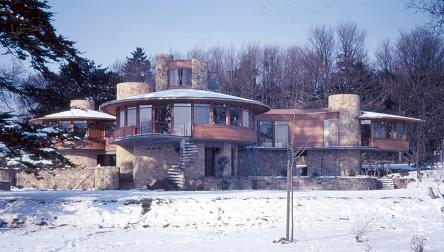
Built by eccentric architect Arthur Marshman on the site of an old tennis court, Horton Rounds has broad curving eaves and a chimney made of local yellow stone.
Ultimately, however, the house is more notable for its unusual shape: it's designed to look like a comma next to a full stop.
View Larger Map
Labels: geekery, punctuation
National Grammar Day:
No Time for Diatribes Edition
Tuesday, March 4, 2008 2:40 PM
(If you find yourself liking the comic, please go back and start at the beginning.)
Labels: geekery, National Grammar Day, spelling
I could read Achewood all day, in fact I have.
National Grammar Day:
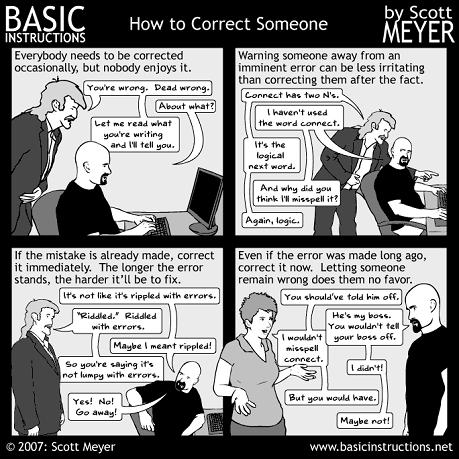
How to Correct Someone
11:12 AM
Labels: geekery, National Grammar Day
Explication of the Nerds
Friday, January 11, 2008 2:54 PM
If that's incorrect... well, I make no apologies when I can't Search Inside!
It's a bit silly to quibble over the meaning of terms that come to us as reclaimed insults — that is to say, via people who really don't care whether they call you a geek or a nerd or a dork — but this definition goes against what I've (almost certainly naively) understood as a commonly-held distinction between nerds and geeks.
That would be something like what you get at the end of the Nerd? Geek? or Dork? Test:
A Nerd is someone who is passionate about learning/being smart/academia.
A Geek is someone who is passionate about some particular area or subject, often an obscure or difficult one.
A Dork is someone who has difficulty with common social expectations/interactions.
I consider myself mainly a geek (that is, an English geek), but I score high in all three categories. Of the three terms, only dork seems negative to me anymore. Geeky is, of course, the new cool.
(Related: In his neo-fantasist gamer novel Lucky Wander Boy, D.B. Weiss offers an eloquent albeit chauvinist definition of geek: "A geek is a person, male or female, with an abiding, obsessive, self-effacing, even self-destroying love for something besides status." He's also very critical of faux-geek chic, a.k.a. dorkface.)
There are different schools of thought on this — for example, some people think that a nerd is just a dorky geek — but Dr. Anderegg's purported definition struck me as especially unusual.
Also: since this is a book about nerds, a few of the reviewers decide to repeat the claim that Dr. Seuss coined the word nerd in 1950.
Here's the Washington Post:
(It should be noted that another literary icon actually coined the word nerd, which first appeared in 1950 in the completely irrelevant, and typically fantastic, context of Dr. Seuss's "If I Ran the Zoo": "And then, just to show them, I'll sail to Ka-Troo, and bring back an IT-KUTCH, a PREEP, and a PROO, a NERKLE, a NERD, and a SEERSUCKER, too.")
And here's the Economist:
How very unfortunate that Dr Seuss, whose verbal pyrotechnics have given so much pleasure to so many children, should also have given them, however innocently, the ghastly label "nerd".
It's certainly the first published occurrence of the term discovered so far, but some people, including Our Bold Hero, think that the connection between the two nerds is mere happenstance, and that Seuss' word was another whimsical one-off that went nowhere.
The website The Origin of the Nerd has the low-down on this etymological controversy, but right now the earliest citation for nerd outside of Dr. Seuss is from 1951. I doubt that I'm the only would-be antedater for whom this word has become something of a white whale.
Relieved to say I scored "pure nerd."
What's up with "dork"? -- it's the only one of the three that doesn't emphasize some kind of intellectual ability. Makes them sound . . . unfortunate.
Ella Minnow Pea
Wednesday, January 9, 2008 1:25 PM
If you can parse that description, bravo: that's prettymuch the gist of the book.
The story takes place on a hyper-literate island (stuffy cacozelia abounds!) where the fictional Nevin Nollop is revered for having invented the pangram the quick brown fox jumps over the lazy dog.
(As I had to remind one confused client, that pangram is now used to test fonts; it's not a substitute for Lorem ipsum, no matter how many times you cut and paste.)
The sentence is immortalized on a monument to Nollop, but when one of the letter tiles (z) falls off, the Island Council decrees that the corresponding letter should be banished from all writing and speech, a ruling they enforce with harsh penalties. Unfortunately, it turns out that z wasn't the only loose tile...
(Incidentally, the letter Z has met this cruel fate before: it was officially banished from Icelandic first in 1918, then again, decisively, in 1974.)
The story that unfolds is told entirely through the letters characters send each other, letters that become progressively more constrained as more of the letter-letters are taken away. I think that the author cops out a little at the end, but the effort is nevertheless impressive.
However, that's prettymuch all there is to this book: it's a nice little nothing with an amusing conceit, equivalent to one of those books where the author lives in a weird way for a year. Still, was it worth a couple hours of reading time? Definitely.
(I'm a sucker for the almost non-existent "hyper-literate alternate universe" subgenre. The Eyre Affair is a must-read for any English major, although you should stay away from the other Thursday Next novels.)
With its strange, diminishing alphabet, Ella Minnow Pea reminded me of a sci-fi short story I'd just recently read, Kim Newman's "Tomorrow Town." In the Tomorrow Town alphabet:
Q and X are replaced by KW and KS; the vestigial C exists only in CH and is otherwise replaced by K or S. E.g.: "The kwik brown foks jumped over the layzee dog."
So forget z; apparently it's the letter C that doesn't get any respect. Benjamin Franklin wanted to get rid of it too (along with j, q, w, x, and y) and a quick Google search turns up some present-day haters.
None of that for me. If it does anything, Ella Minnow Pea will make you appreciate the awesomeness of every single one of our letters.
(And book title puns involving eye dialect, if I'm indeed using the term correctly. In any case: that looks hard.)
I mourn for the letters we've lost - ash and thorn spring to mind. Man, they even had cool names.
On the plus side, we might gain some additional letters in the future. It's more of a symbol, but just look at the way '@' has come on in recent years...
Glad you liked the book!
I haven't read it since college -- maybe it's time for another read! And I'll take your linking advice to heart.
The Distracting Word Meme
Sunday, December 30, 2007 2:11 AM
Words that always look misspelled to me
adviser (clearly a pet peeve of mine)
separate
dilemma
whisky
Words that look nicer in italics
far
murderous
Words I enjoy saying
h.c. (for hardcore)
introvert
roger
hence
solid (instead of favor)
Words I enjoy hearing
"abzurd"
jerkin' (Josie and the Pussycats)
yonder
killjoy (Halo 3)
Abbreviations I dislike
MILF (and its lexical offspring are even worse)
micro (for microwave)
s/f or SF (instead of sci-fi)
Proper nouns I enjoy
Londonderry
Harvey Wallbanger
McKean's Law
Words I associate with happiness
breeze
malt
twilight
Words I always misspell
periphescence
misspelling
Words I enjoy spelling correctly, every time
complimentary
stationery
Albuquerque
Words that, though I love their meaning, I'm too embarrassed to say out loud
bailiwick
f*ckbuddy
bloviate
whence
seigniorage
Words I can never remember the meaning of no matter how many times I look them up
cacozelia
crepuscular
lacuna
The word whose meaning I can never remember is "jejune."
As for MILF, have you heard about Spirit Airlines' MILF promotion? They claim they had NO IDEA it stood for anything but "Many Islands Low Fares." Right-o. More info here: http://commercial-archive.com/node/141850
Fantastic words! Breeze is a happy word isn't it? Hence does feel good in the mouth. And you are right, murderous looks great in italics :)
The thing about "sci-fi" is that it's something of a shibboleth. There are communities where it's got a history as a patronizing and derogatory term, generally aimed exclusively at bad film and television science fiction, and so if you use it around members of those groups, you will mark yourself as an outsider, and ignorant of their mores. 'SF' has no such connotations to navigate.
Yeah, I don't mean to open a can of worms there — I did that already with a "videogame vs. video game" post — but I'm aware of the arguments for "speculative fiction" and "sf" as opposed to "sci-fi." I just think that, as a label for straight-up science fiction, "sf" is overused within the community of people that has no narrow-minded prejudices against "sci-fi."
If you don't want to open a can of worms, maybe hanging up loaded phrases like "narrow-minded prejudices" before you start may be helpful.
Hah! Fair enough. I guess I didn't think it would be controversial to say that people who don't like sci-fi because it's called "sci-fi" are being narrow-minded.
I suspect that the people who don't like the term "sci-fi" are primarily the really big sf fans...?
There should be a category for words that you always seem to misread, no matter how common they are.
My two worst offenders are "misled," which I always want to read as [mai.zld] and "uniformed," which I usually see as "uninformed."
Where did you get the idea that I was talking about people who don't like science fiction in discussing people who don't care for the term "sci-fi"?
I took you at your word when you said, "I'm aware of the arguments for 'speculative fiction' and 'sf' as opposed to 'sci-fi'," but if in fact you're supposing that the likeliest opponents of the term "sci-fi" are people who are not fans of the genre, then I'll have to conclude you were talking through your hat.
It's precisely among fans of science fiction as a literary genre that the term "sci-fi" may be objected to most strongly. And to call that objection narrow-minded might be likened to calling a person of color narrow-minded for objecting to the term "coon".
Is that a bit clearer?
I think "coon" is a poor comparison, since it's incredibly perjorated, whereas I highly doubt that I'm the only sci-fi fan who still finds the term "sci-fi" innocuous. A sometimes-contentious, increasingly unfashionable label like "hipster" might be a more apt — albeit less dramatic — comparison.
But obviously it's I who's been having trouble being clear. Since my first comment we've been talking about two different groups: I mentioned that I was aware of "the arguments for 'speculative fiction' and 'sf' as opposed to 'sci-fi'," saying that I didn't mean to open a can of worms. I added, however, that I thought those terms were overused within the community of people with no narrow-minded objections to the term "sci-fi," i.e. the community of science fiction fans. I think it's here that I lost you.
I have no bones against the people who use the term "s/f" so that certain works can gain a broader acceptability, or refer to "speculative fiction" because it's a useful umbrella term. I disagree with them and continue to dislike these terms, but however strong their opinions about the word "sci-fi", these fans can presumably still look beyond the label. In short: I wasn't trying to call a subset of science fiction fans narrowminded; I was referring to a different group of people, as I made explicit in my second comment.
I do think that the likeliest, if not the most vociferous, pejoraters of the term "sci-fi" would be the general public (i.e. non-fans and some of the casual fans). As far as I can tell, it's largely their perception of sci-fi that has given it a connotation as a "patronizing and derogatory term, generally aimed exclusively at bad film and television science fiction."
I see "speculative fiction" as a rebranding, an escape from a genre pigeonhole necessitated by the pejoration of "sci-fi" within the general public. And so you get people like Margaret Atwood saying stuff like "No, it certainly isn't Science Fiction. Science Fiction is filled with Martians and space travel to other planets, and things like that."
Compare "progressive" with "liberal," a label which was until quite recently still in use here in Minnesota, but which was abandoned mostly because "liberal" had become a dirty word. This very blog is premised on a similar rebranding: the abandonment of "descriptivist grammar" (in favor of "reactive grammar") because the prescriptivists have made "descriptivist" out to be something crazy.
So now that we're using a different label some people who used to be called "descriptivists" can call descriptivism "utterly insane." Likewise, having abandoned the label "sci-fi" for serious works, it seems like a certain subset of science fiction fans have begun using it in the pejorated sense. Your point in your first comment was, and still is, well-taken: among that group of science fiction fans, "sci-fi" has become a shibboleth.
I'm starting to wonder if "sci-fi" might be what's sometimes called a "skunked term" — "a disputed word that has undergone a semantic shift, thus making it difficult to use it in either the older or the newer sense. Sticking to the older sense confuses those unfamiliar with it, while using the newer sense annoys traditionalists who feel that it is wrong." Although I suppose in this case both sides seem to end up annoyed.
Questions from the general public
Wednesday, December 19, 2007 3:44 PM
Last year there was only one language-related question on the list — "How can I tell if I was the first person to use the term 'K-fed-up' in relation to Britney's divorce?" — but this year there are several, presented here for your bemusement:
Hello. I am an editor and writer and I would like for everyone to change some letters that are now in lowercase to uppercase. An example would be the 18th century to the 18th Century. Where does one go about starting to do this?
Why does having a foreign accent make a person seem more attractive?
I've been looking for information on how the word "dick" became an insult, especially since people still go by the name Dick. Why would anyone choose that name, when it has other meanings?!?!
Is it "open sees me" or "open says me"?
Feel free to offer your answers in the comments; I've already found some basic info on Dick/dick and open sesame in case you're curious.
(For anyone who truly craves answers, I highly recommend Wired's smart answers to silly questions.)
Labels: geekery
Apples and oranges and pears, oh my
Monday, December 17, 2007 5:59 PM
Today on the BBC (i.e. last week for you) I heard the following exchange:
BBC: If someone in the Army drinks so much alcohol that they are incoherent, which I'm sure happens, what happens to them?
Government guy: Well, first of all, of course, alcohol is a legal drug, therefore you are comparing apples with pears.
I hadn't encountered the idiom comparing apples with pears before, but a quick Google search shows that it isn't new. Moreover, Wikipedia claims that the "Danish, Dutch, German, Spanish, Swedish, Czech, Romanian, Luxembourgish and Turkish" expressions all involve pears.
The delightful Asperger Dictionary of Everyday Expressions explains apples and pears thusly:
Describes an unfair comparison because what are being considered are too fundamentally different for the comparison to make sense. Thus, comparing apples and pears is a foolish thing — they taste different and which one tastes nicer is a matter of personal opinion, not objective fact.
I found it odd that the apples and oranges entry refers you to apples and pears, rather than vice-versa, so I was relieved to discover that the more familiar comparing apples and oranges is indeed much, much more common. I'm not in an episode of Sliders after all.
Textbook definitions aside, there's obviously plenty of connotative difference between apples and oranges and apples and pears — from the way this guy said it, you got the impression that a comparison with pears would beyond inadvisable. And even if some or all of us would still prefer to use the hoarier oranges version, there's no denying that for an English-speaker, the pears version is far fresher.
(And we could do better — no need here to get into the snowclone comparing apples and X.)
Unfortunately, their very novelty tends to make fresh-sounding idioms vulnerable to overexploitation, an idiomatic Tragedy of the Commons. Remember when bleeding edge was the hip new version of cutting edge?
I had never heard "apple and pears"--thanks for the update!
I would never use "apples and pears," because apples and pears are actually quite a bit alike.
They have cores w/ multiple seeds. Their peels are a similar thickness. Their flesh has a similar consistency. Even the tastes are more alike than they are different.
In fact, there is a pear that tastes a LOT like an apple.
Compared with either apples or pears, oranges have vastly different structures to their seeds, their peels are different, and their flesh is hugely different, both in consistency and taste.
I think apples, oranges and pears are all too similar. We need a new expression, 'apples and condolences' perhaps...
Presumably you guys could work that into the house styleguide and act like all the writers who use "apples and oranges" should know they're wrong.
I'm toying with the idea of using a random noun in the "oranges" slot in my own writing, but I doubt that I use this expression more often than once every few years.
But, of course, "apples and pears" rolls naturally off the English tongue; it's cockney rhyming slang for "stairs".
I Love You But I've Chosen X
Saturday, November 10, 2007 10:01 AM
For snowclone fans, the latest comic is worth reading for the final panel alone.
A quick Google search turns up numerous variations on I love you but I've chosen X:
I love you but I've chosen dockers.
I love you but I've chosen disco.
I love you but I've chosen dorkness.
I love you but I've chosen dungeness crab.
I love you but I've chosen Tottenheim.
I love you but I've chosen Charm.
I love you but I've chosen men.
I love you but I've chosen Awesomeness.
I love you but I've chosen waffles.
I love you but I've chosen grad school.
And so forth. The reference is almost certainly to the indie rock group I Love You But I've Chosen Darkness, which released a self-titled EP in 2003.
I know: no comma! I had to go back and delete the dozen or so I'd instinctively added.
I Love You But I've Chosen Darkness is a pretty good name, but my favorite band name is still the one an acquaintance in college adopted for his (presumably now defunct) band: Alternate Universe Escape Plan B.
(My favorite word is notwithstanding, for similar reasons.)
Labels: geekery
As a Brit, I really, really want to change that last band name to 'Alternative Universe Escape Plan B'...
Alternative Universe, really? I hadn't realized this use of "alternate" was such an Americanism. I suppose you've no "alternate routes" then, either... strange...
Ladies and gentlemen: Batman
Friday, October 5, 2007 9:25 AM
Robin: "You can't get away from Batman that easy!"
Batman: "Easily."
Robin: "Easily."
Batman: "Good grammar is essential, Robin."
Robin: "Thank you."
Batman: "You're welcome."
Batman: "Cattail Lane and Nine Lives Alley. The Grimalkin Novelty Company is on that corner."
Robin: "Grimalkin? What kind of a name is that?"
Batman: "An obscure but nevertheless acceptable synonym for cat, Robin."
For more good language-related miscellanea, I highly recommend the language-tag posts over at Futility Closet.
Labels: geekery
I can see through time!
Monday, September 17, 2007 7:21 AM
Labels: geekery
The defensive obviously in Tricked
Thursday, August 30, 2007 7:27 AM
Whether this spelling reflected Robinson's personal opinion on the matter or was merely character-correct, it was still a bold choice.
I looked through Tricked twice (it's interesting how we no longer say scanned here) for instances of either a lot or alot. I didn't find anything, but on his blog, Robinson uses a lot.
Assuming that alot did reflect some descriptivist leanings, has this erstwhile People's Hero undergone a prescriptivist conversion? There's a quirk in Tricked that makes me suspect he has. Spoilers, ho!
Check out this deployment of obviously:
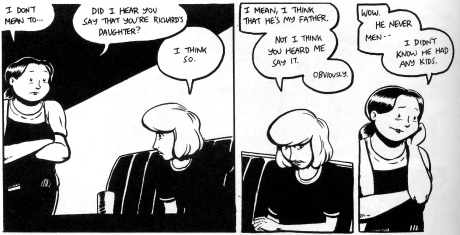
This happens several times in the book. A character will say something that has both an obvious, correct interpretion and an unlikely, yet still grammatically correct interpretation, and then make a point of how they can see both interpretations and are smart enough to go with the obvious, correct one.
Here's another example, in parentheses at the bottom:
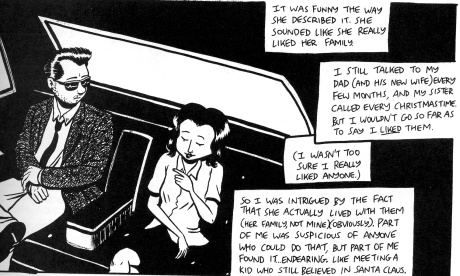
This only happens about three or four times in the novel, but it's enough to stand out. I know that it's probably meant to be amusing... but there are a lot of ways to be amusing and this was an odd choice. Why would anyone think like this?
These characters seem to be constantly on guard against improbable but grammatical misinterpretations — putting aside deeper readings here, it really makes me wonder if Robinson had a bad experience with an overzealous editor. Something that might have left him with a copy editor's eye and this prophylactic tic.
Labels: geekery, grammar politics
Hoisted by someone else's pike
Monday, August 20, 2007 8:47 AM
Apropos of an argument over whisky vs. whiskey:
Female coworker: Pike down! No harm, no foul here!
Male coworker: You just called me a PIKE!
Female coworker: I didn't call you PIKE, I requested that you pike down!!!! Don't make me have Dan look up and explain the meaning on this one too!!!!
Our Bold Hero: A common error per Google, but apparently not the original expression...
On sailing ships signals were given to the crew by sounding the boatswain's (bo'sun's) pipe. One such was 'piping down the hammocks' which was the signal to go below decks and retire for the night. When an officer wanted a sailor to be dismissed below he would have him 'piped down'. This usage is recorded in Royal Navy workbooks from the 18th century.
Female coworker: Ok - now Dan caught me... PIPE down dang it!!!!
Our Bold Hero (to male coworker): I pissed her off methinks, but this whole pipe/pike thing is fascinating. The technical term (which I was just reading about last week!) for her error is 'pineapple' -- it's a species of malapropism. Whoo! Words!
Male coworker (forwards my message to everyone): HA ha!
Female coworker: Be fascinated with somebody else's words!!! Peaceout!!!!
There goes my chance to ask if peaceout was an intentional runtogether...
Josie and the Usage Quirks
Saturday, August 11, 2007 2:21 PM
If you've never heard of Josie and the Pussycats, the movie is a satire of consumerism, complete with ubiquitous unpaid product placement throughout. There's also some language-related goodness.
X is the new Y
To parody faddishness, the movie makes extensive use of the snowclone "X is the new Y," as you can see in the examples below:
Pink is the new red!
Orange is the new pink!
Blue is the new orange!
Feathers are the new rhinestones!
Tretorns are the new Adidas!
Gatorade is the new Snapple!
Josie and the Pussycats are the new Du Jour!
Diet Coke is the new Pepsi One!
Heath Ledger is the new Matt Damon!
Alan M.
I know nothing of the Archie Comics universe, but I couldn't see Alan M. without wondering what, if anything, the M stands for. As one character observes, "Yes, what's with the initial anyway? It didn't work for Sheila E., and it doesn't work for you." One fan site unhelpfully notes that
Although for many years the "M" in his name was a mystery, Archie Comics now gives his name as Alan M. Mayberry.
But that doesn't settle anything; it just makes us wonder which initial Alan is using. In the meantime, we're left with a lesser version of the Harry S Truman vs. Harry S. Truman debate. Is it properly Alan M Mayberry or Alan M. Mayberry? I'd personally go with the latter: the period should only be omitted when we know it's not an abbreviation.
Jerkin'
Lastly, the movie coins its own word for cool, and uses it pretty faithfully. When a character later says cool instead, she's accentuating an important plot point. Here's the coinage:
Woman 1: "The new word for cool will be jerkin', as in 'Dude, that's jerkin'!'"
Woman 2: "Ooo, that's dirty."
Bemusement for me,
Amusement for the CCed
Saturday, July 14, 2007 11:25 AM
They are!
Labels: geekery, punctuation
In the future they have no spaces
Wednesday, July 11, 2007 9:32 PM
Equally surprising was my discovery that the phrase box office poison is fairly old, an apparent Americanism dating back at least to the 1920s and probably decades earlier.
One of the main characters in Box Office Poison is an English major who works at a bookstore, and the book features a number of stupid customer stories. For my part, I think that Robinson is a bit hard on people who mispronounce titles and authors' names: there are a lot of people out there who can't pronounce Don Quixote. In high school I was fairly well-read for my age, but I wouldn't have known to say "kee-HO-tee" if not for an episode of The Simpsons.
The adjective quixotic did not help matters: I was often unjustly accused of mangling it.
But whatever. The stupid customer stories help establish the Robinson's authority, and so we know that his decision to write alot is a conscious one, and that characters using alot aren't ignorant. It's an interesting choice.
Despite widespread public usage (as any editor could attest), alot has few defenders among the usage mavens. I have the "A Lot Is Two Words" comic up in my cubicle now and I'm fairly certain that my coworkers aren't laughing at the same joke.
It's nice to see someone standing up for the silent (but alas, inconsistent) majority and using alot in situations where we're not meant to think the character is uneducated.
(The decision to decaptalize Croesus, if indeed it was, is more troubling. Also, has anyone tracked Rich as Croesus vs. Richer than Croesus? I'm curious.)
Regionalism of the day: what all
Wednesday, June 13, 2007 1:10 PM
I asked, "What all kinds of seafood do you have?"
A quick Google search turns up similar Tennessee-related usages. I find this use of what all, apparently predominantly Southern, quite charming.
And stoves will be called "kenmores"
Thursday, April 26, 2007 4:04 PM
(Aside: I've heard the such as vs. like distinction before, and have occasionally copy-edited for it rather than risk even that slight confusion. But I think it's a stylistic trade-off because such as probably sounds stilted to most people of my generation. We are Generation Like.)
For those of you not familiar with elimination-style reality shows, there's often a first challenge (usually for an award) followed by a second, more important challenge (for either a bigger reward or to avoid elimination).
On Top Chef, that first challenge is called the quickfire challenge. I had some problems with Top Chef (i.e. I couldn't taste the food), but quickfire challenge has always struck me as an unusually evocative phrase.
Recently I've noticed that like some of my friends, I've started applying that term unselfconsciously to the first challenge on any reality show. A quick web search confirms that we are not alone in this.
Over at Nerd World, the semantic broadening continues:
Quickfire challenge: what 5 things should the new Hulk movie do differently from the old Hulk movie?
Lev is not the only person doing this. The amazing thing is that even if you miss the allusion — he made it clear with a link, but others don't — this reference is probably perfectly intelligible.
I'd like to think that quickfire challenge has legs. Go neologism, go!
Wordsong
Tuesday, April 24, 2007 9:29 PM
Recently I've been listening to a lot of free music at 3hive, not so much because it's especially good as because it's new. And I think I mentioned the free.
The Metasciences have grown on me, and their song titles have some clever wordplay, e.g. "Afraidioactive" and "TiVo the Revolution."
Not to mention the fact that the first verse of their song "High Noon" is the demented love letter I'll always wish I'd written:
You know that the words I wield
are weapons of sardonic virtue
I just use them as a shield
And I would never, ever hurt you
(Aside: I have looked sardonic up many, many times, and I still don't know exactly when to use it. My last, slim hope is to find the prototypical instantiation of the adjective and extrapolate from there.)
The other 3hive song of English-note was Vampire Weekend's "Oxford Comma." I am a huge proponent of the Oxford comma, and so I just had to download it.
It's a catchy tune, but the unflinchingly descriptivist refrain is the only part of the song I really like. Here's my best guess:
Who gives a fuck about an Oxford comma?
I've seen those English dramas too
they're cruel
So if there's any other way to spell a word
It's fine with me
with me
Neither of these songs comes close to what I really want, but Modest Mouse's "Black Cadillacs" has a few brilliant lines that hint at the Great American English Geek song. Needless to say, I listened to this obsessively my senior year of college, often skipping ahead just to get to the really good part:
And we were laughing at the stars
while our feet clung tight to the ground
So pleased with ourselves
for using so many verbs and nouns
Labels: geekery
The case for prescriptivism
Saturday, April 14, 2007 1:52 PM
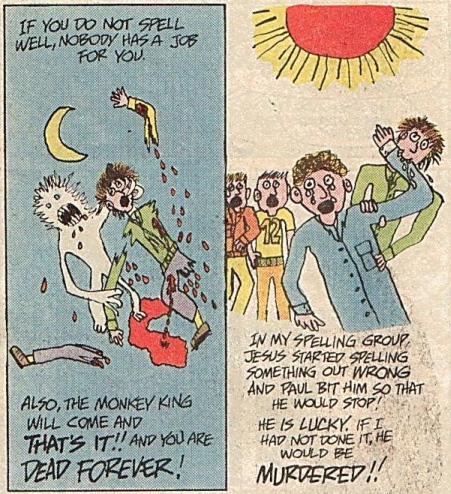
Labels: geekery, grammar politics, spelling
and they say Watchmen is his best work.
Think reactive, not reactionary