A National Punctuation Day Contest
Wednesday, September 24, 2008
9:04 AM
Happy National Punctuation Day!
(Dear official website people, I'm not linking to you because I can't even access your website at work. It has streaming media. Sincerely, Dan.)
So I don't know how to celebrate today. I baked a cake, but unfortunately it's not punctuation-themed; I should have invested in a comma cake pan.
Since the cake was a delicious failure, I've decided to offer a No-Prize (and perhaps something else, if the competition is fierce) to whomever can use the most punctuation marks in one properly-punctuated coherent paragraph without reusing any of them.
Punctuation marks that have to occur as a set (e.g. quotation marks) will count as one point total, and the set can still only be used once. There are no points or penalties for using capitalization or spaces or diacriticals, but use more than one period and you're out.
So have at it, if you're so inclined. Leave your submissions in the comments. The deadline is midnight tonight, Central time.
Bonus punctuation-related content: yesterday Dooce posted an amusing exchange of some slight relevance.
Carol: "Who needs best friends when I have you!!!???"
Me: "Carol, that was three exclamation points and three question marks. Someone out there right now is trying to write a paper and can't because you used up all the punctuation."
No one will ever pick up on this hyperbole
Monday, September 22, 2008
1:29 PM
Speaking of signs, remember those guys who were fined for correcting a sign at the Desert View Watchtower in Grand Canyon National Park?
Well, the promised "Statement on the signage of our National Parks and public lands" is up at the old Typo Eradication Advancement League website, and... does anyone else think it's a little snotty?
Sample quotes:
"It is absolutely egotistical for one to think that one can tell others how to spell."
"The act of vandalizing or damaging signs on the National Parks and public lands has a historic and archaeological impact that one cannot underestimate."
"Certain of the signs may have been put into place at the birth of the park, thus representing as intrinsic a part of its identity as any tree or canyon [sic!] within the park."
Moreover, the statement points out twice that "Altering signs without the permission of the owner is a crime!!" Without reading too much into it, I'll just observe that the old TEAL posts that I've seen always only used a single exclamation mark. So this is a little odd.
(I've been offline for a few days, and I see now that friend-of-the-blog Mighty Red Pen already wrote about this a few days ago. She too found TEAL's sudden embrace of orthographic radicalism more than a little surprising.)
I posit hidden government-run descriptivist re-education camps in unmapped areas of the American Southwest. Or in a secret base within Pikes Peak, the obvious headquarters for any organization that doesn't think spelling matters.
A spirited defense of good grammar
Friday, September 12, 2008
4:12 PM
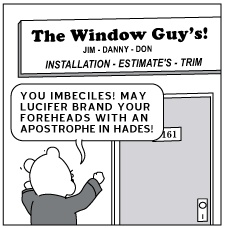
Today is that greatest of Achewood holidays, Fuck You Friday. Check out Mr. Bear in the final panel:
Like manyotherwebcartoonists, Chris Onstad usually adds a comment to the image title field. Today's is "Seriously, like ten people are involved in making signs. How do these things go unnoticed?" In-deed.
Feel like celebrating? Here are the other Fuck You Friday strips:
The Apostrophes of Canada
Thursday, August 21, 2008
11:24 AM
It seems like these days everyone is talking about the semicolon (it's so hot right now!), but I think John McIntyre summed up the situation nicely:
I wonder at the writers who carp and cavil about the semicolon, finding it unpleasant, artificial or even ugly, when it is the apostrophe that is the source of most of the trouble in English punctuation — inept plurals, bungled possessives, nasty little hooks in the wrong place all over the landscape
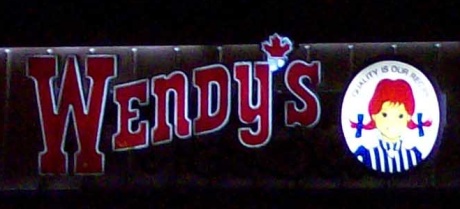
It should come as no surprise that Canadians have all the usual issues with the apostrophe, though I have to give them some props for their invention of the Canostrophe.
These were everywhere as soon as we crossed the border. Here's one on an Arby's sign. I could've sworn that I saw one on a McDonald's somewhere, but the Internet is skeptical.
Fact: in a perfect world the Canostrophe wouldn't be restricted to signage, and MS Word would autocorrect regular apostrophes for users in Canada.
Apostrophes were notably absent on all signage for the ubiquitous Tim Hortons, birthplace of the repeaterdouble-double, a Canadian term for "coffee with two creams and two sugars."
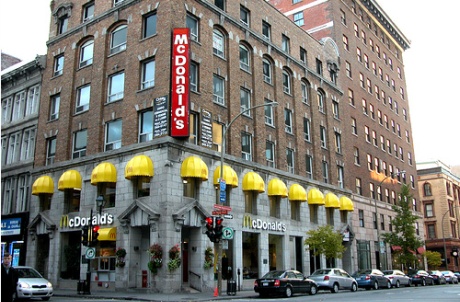
There are theories that the lost punctuation in Tim Hortons has something to do with Quebec's language laws, but then why does this McDonald's in Montreal get to have apostrophes?
I think on vertical signage, you lose all punctuation (apostrophes, hyphens).
I love the semicolon! And I'm w/ John McI--the apostrophe looks uglier and gets used wrong more often.
I've never understood animosity toward the semicolon. I've seen it overused, but I don't understand why its existence anywhere draws such condemnation.
I don't know what you's guy's are talking about! What's up with these here grammar rule's anyhow? Here, in BC, we use'd our language good. We's not a bunch of Canucknucklehead's you now! Eh!!!
BGN Geekery: The Apostrophe Problem
Monday, April 21, 2008
11:32 PM
The U.S. government is stingy with apostrophes in its official names; the most notorious case is probably Pike's Peak, a.k.a. Pikes Peak. Pike's Peak is named after Zebulon Pike, and so Almighty Grammar would dictate an apostrophe... yet the official spelling is Pikes Peak. And yes, for all my descriptivist tendencies, this official misspelling really bugs me.
The U.S. Board on Geographic Names FAQ defends this decision at length. I still disagree with them, but their response is so interesting that I've excerpted it in its entirety here:
Since its inception in 1890, the U.S. Board on Geographic Names has discouraged the use of the possessive form — the genitive apostrophe and the "s". The possessive form using an "s" is allowed, but the apostrophe is almost always removed. The Board's archives contain no indication of the reason for this policy.
However, there are many names in the GNIS database that do carry the genitive apostrophe, because the Board chooses not to apply its policies to some types of features. Although the legal authority of the Board includes all named entities except Federal Buildings, certain categories — broadly determined to be "administrative" — are best left to the organization that administers them. Examples include schools, churches, cemeteries, hospitals, airports, shopping centers, etc. The Board promulgates the names, but leaves issues such as the use of the genitive or possessive apostrophe to the data owners.
Myths attempting to explain the policy include the idea that the apostrophe looks too much like a rock in water when printed on a map, and is therefore a hazard, or that in the days of "stick-up type" for maps, the apostrophe would become lost and create confusion. The probable explanation is that the Board does not want to show possession for natural features because, "ownership of a feature is not in and of itself a reason to name a feature or change its name."
Since 1890, only five Board decisions have allowed the genitive apostrophe for natural features. These are: Martha's Vineyard (1933) after an extensive local campaign; Ike's Point in New Jersey (1944) because "it would be unrecognizable otherwise"; John E's Pond in Rhode Island (1963) because otherwise it would be confused as John S Pond (note the lack of the use of a period, which is also discouraged); and Carlos Elmer's Joshua View (1995 at the specific request of the Arizona State Board on Geographic and Historic Names because, "otherwise three apparently given names in succession would dilute the meaning," that is, Joshua refers to a stand of trees. Clark's Mountain in Oregon (2002) was approved at the request of the Oregon Board to correspond with the personal references of Lewis and Clark.
I've always wondered about the aversion to apostrophes. My parents recently lived in a town called Scottsbluff, which is named after a nearby bluff named after a man named Scott.
Not only is the apostrophe missing, but so is the space, which makes me want to say it with primary stress on the first syllable and no stress on the second, when in fact it's pronounced with secondary stress on the first and primary stress on the second.
If you scroll down towards the end of the story, however, you'll find that the Guardian has assembled some interesting quotes under the heading "An elegant pause — or merely a 'pretentious comma'?" Kudos to Jonathan Franzen for this one:
I love a good semicolon, but this sounds like one of those Literature is Dead! stories that the New York Times likes to run. I've never heard from a reader confused by one of my semicolons, and I don't remember ever throwing a book aside for being semicolon-free.
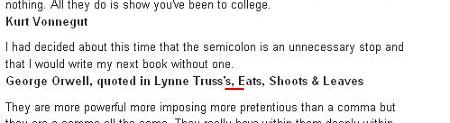
Also, since I blogged about the Eats, Shoots & Leaves Curse yesterday, I should note that another mention of her book has tempted fate. This time the problem is an extraneous, incorrect — dare I say bad? — comma:
Thanks for the link. For what it's worth, I don't think the punctuation debate is particular new here (read: Europa) either. Still, good to know that the humble semicolon can still rouse passion. Good or bad!
Oh, and I emailed the Guardian about the errant comma you also spotted. No reply yet. Probably still checking their point-vigules.
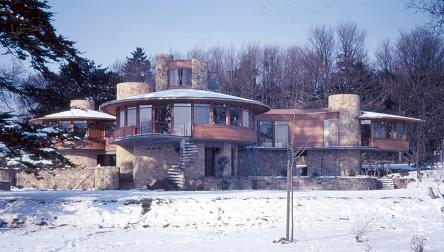
Built by eccentric architect Arthur Marshman on the site of an old tennis court, Horton Rounds has broad curving eaves and a chimney made of local yellow stone.
Ultimately, however, the house is more notable for its unusual shape: it's designed to look like a comma next to a full stop.
As a fan of the semicolon I really enjoyed this article, which mixes praise for star punctuator Neil Neches with trivia about this increasingly disregarded mark.
(Notable: "In 2004, a court in San Francisco rejected a conservative group's challenge to a statute allowing gay marriage because the operative phrases were separated incorrectly by a semicolon instead of by the proper conjunction.")
Anyways, check it out. This is probably the only time you'll ever see kudos from pop-grammarian Lynne Truss right alongside kudos from linguist Geoffrey Nunberg, who once said of Truss: "you can't help feeling that the self-mockery is a cover for self-congratulation."
(The story's misspelling of "Eats, Shoots & Leaves" as "Eats Shoots & Leaves" — the NYT issued a correction today — is tragic on many, many levels.)
Wow. I just discovered your site while settling an argument with my roommate concerning the Oxford comma (and yes, it was prompted by the "Vampire Weekend" song). We were both English majors, so this sort of thing comes up regularly.
I, too, am a huge semicolon fan.
I'm not sure if you have posted about this yet and I just missed it, but I am very troubled by the growing trend of using quotation marks for emphasis. For example, I've seen signs in store windows where the product is in quotes. One sign that I recently saw said "ORANGES". Why the need for quotation marks?
This story has word nerds all a-flutter now, doesn't it? Has anyone seen the actual sign? The story in the NYT just had a picture of the semicolonist, er, semicolonialist, er, semicolonizer . . .
The editor of a magazine I used to work for banned editorial staff from using semi-colons (in the publication, not in their private life). As such I have a special fondness for this particular punctuation mark.
Now that's an excellent question. Hopefully it's an attempt to be hip (spaces being old hat) and not some weird ideological or philosophical decision. In any case, I'm amazed that whoever thought this up was able to get the approval.
"Greenpeace actions are illegal under international law (and) it's time the public stopped treating Greenpeace as heroes," Glenn Inwood, spokesman for the Institute of Cetacean Research, in Tokyo, Japan, said Monday.
No, I don't care about the whales. Well, maybe I do — but that's not the really interesting thing here.
Which is: what the hell is going on with that (and)?
I mean, instead of a colon or a semicolon or a period or a dash, some copy editor has decided to insert a bracketed and into the sentence. Maybe he merely allowed a writer to get away with it, but let's assume an ideal copy editor here.
(For those without a trusty AP Stylebook: they use parentheses for brackets due to technological restrictions.)
There's no need to insert your own word to fix this direct quote, not when punctuation would suffice. Personally, I think that a semicolon (remember the semicolon?) would be the best option, as it sets up the same sort of nonspecific connection between two statements that (and) does here — but you could make arguments for any of the marks I mentioned above.
To ignore all those options and choose (and) is... a failure of the imagination.
Moreover, despite this bracket-craziness, they still begin the quote Greenpeace actions are illegal instead of (Greenpeace's) actions are illegal. I mean, what makes an action Greenpeace? Is ordering pizzas for your anti-whaling boat crew a Greenpeace action, if you get a receipt?
(It's also interesting that the CNN and USA Today versions of the same AP story with the same New Zealand dateline have Mr. Inwood speaking on Monday and Sunday respectively. Time zones are hard, I guess.)
Ugh. I think a good rule of thumb is to never insert something in brackets (or remove something with ellipses, for that matter) unless you really have to. And if the plain quote is ugly or unusable for some reason without heavy editorial intervention, then maybe you should find a different quote or simply paraphrase.
Which began as Punctuation Day
Monday, September 24, 2007
11:23 AM
[!] National Punctuation Day, of course.
The official website is a good general guide to segmental punctuation (i.e. the punctuation marks), even if it does come down on the wrong side of the whole Oxford Comma debate.
The emoticons and proto-emoticons are missing from the official website, but they're informal and they don't really require usage explanations. And I can forgive the omission of obscurities like the answermark and interrobang, because — face it — no one ever uses them.
(Once, while researching a paper in college, I stumbled upon a book of literary analysis for which the author had invented — god — like seven different punctuation marks. Because, you see, his ideas were too subtle for our incredible, existent punctuation system. It was all a bit absurd, but today I really wish I remembered the name of that book.)
The absence of the long hyphen (a.k.a. en dash) is slightly more troubling... I'll always try to remember you, little buddy.
But enough quibbles — the day is a great idea no matter what minor issues we might have with the website. Today is about punctuation: it's a holiday for prescriptivists and descriptivists alike.
Anyone who knows me shouldn't be too surprised to learn that it was the chapter's invention/use of a precise technical vocabulary to describe punctuation concepts that intrigued me the most. Below: some highlights.
Here's an early, crucial distinction between segmental and non-segmental punctuation.
The punctuation marks are all segmental units of writing — i.e. they fully occupy a position in the linear sequence of written symbols. There are, however, various non-segmental features which can serve the same kind of purpose as the punctuation marks. For example, titles of literary or other works may be italicised as an alternative to being enclosed in quotation marks.
Note that the Cambridge Grammar classes accents and umlauts as spelling, not punctuation — I don't have my own copy (yet), so I'm curious to see how they classify the New Yorker's use of diereses. That looks like non-segmental punctuation to me.
Before they get into the nitty-gritty of punctuation, the authors make a distinction between signifier and signified that would make Saussure proud:
In virtually all written material the apostrophe is physically — or, as we shall say, graphically — identical with a single quotation mark. We need, therefore, to distinguish between two kinds of concept which we will call indicators and characters. The characters are the graphical shapes, or symbols, that realise the indicators. Apostrophe and single quotation mark are then distinct indicators that may be realised by the same character.
In terms of specific punctuation, I enjoyed the lengthy discussion of How Commas Work, but it's much too long to quote here in any meaningful way.
However, there's a great part about the three types of hyphen.
At the first level we can distinguish three uses of the (ordinary) hyphen:
i. To join grammatical components in complex words: the hard hyphen
ii. To mark a break within a word at the end of a line: the soft hyphen
iii. To represent in direct speech either stuttering ('When c-c-can I come?') or exaggeratedly slow and careful pronunciation ('Speak c-l-e-a-r-l-y!')
The terms 'hard' and 'soft' are taken from word-processing: a hard hyphen is introduced into a document by a keystroke, while a soft one is inserted by the word-processing program.
Why — why? — did they not name that third hyphen type? The English geekery gods can be so cruel.
There's also a section on the en dash, which they call the long hyphen. I keep promising myself that I'll start using this consistently, but it's clearly the forgotten punctuation mark:
This is used instead of an ordinary syntactic hyphen with adjuncts consisting of nouns or proper names where the semantic relation is "between X and Y" or "from X to Y":
[...]
It can be used with more than two components, as in the London–Paris–Bonn axis. It is also found with adjectives derived from proper names: French–German relations. There is potentially a semantic contrast between the two hyphens, as in the Llewelyn–Jones Company (a partnership) vs the Llewelyn-Jones Company (with a single compound proper name). This hyphen is also used in giving spans of page numbers, dates or the like: pages 23–64, Franz Schubert (1797–1828).
Finally, there's a brief hat-tip to the separation apostrophe. This indicator category presumably includes the common-but-nonstandard greengrocer's apostrophe, but their examples mention only the form I've taken to calling the special-assignment plural apostrophe-S, the style choice that launched a thousand incorrections:
iii. separation: A's PhD's if's 1960's
A minor use of the apostrophe is to separate the plural suffix from the base, as in [7iii]; this occurs when the base consists of a letter (She got three A's in philosophy), certain kinds of abbreviation, a word used metalinguistically, or a numeral.
I'm woefully short of dead tree reference materials, but I'm not too surprised.
It seems like at least some version of this apostrophe should be standard for everyone, and that the people who get upset by it wouldn't if they would just stop and think about it...
Wundergrammar: Colon-Break Quotes
Tuesday, August 7, 2007
9:27 PM
Less exciting than my discovery of semicolon quotes, but still notable: this writer introduces all direct quotations as if they were block quotations. That is to say, with a colon, no quotation marks, and a break in the text:
Cordilia said: Thank you and good luck.
When I got to her station she said: How can I help you?
Though I suppose that even for block quotes these are unusual, since most people would probably add a blank line before the quote. And indent!
In any case, it's pretty safe to say that we're all a bit confused about quotations. For my part, last summer I went through a phase where I was refused to add in a comma when using said to introduce a quotation — now I have to coach writers who ignore this convention that it's our company style.
While most college-educated people (or at least, most English majors) probably agree on the basic mechanics of quotations, there are still sticking points out there — dark, warm places where prescriptivism can fester.
For example, from what I've seen, I'm at odds with much of America in my belief that the verb state can introduce only indirect quotations, not direct quotations. It also looks very weird when people introduce a paraphrase with stated instead of stated that. Such are my correctness conditions.
More than once, I've edited writers who broke both these 'rules' and used stated rather than said. Exclusively.
(It would be interesting to know what speaking verbs can introduce a paraphrase without that for most people. I'd guess that more than 90% of English speakers, whatever their preference, would have no problem with He said the dog was brown.)
The Wundergrammar: Semicolon Quotes
Wednesday, July 25, 2007
2:35 PM
A curiosity: I just finished editing a writer who did not punctuate quotes in the usual style. Instead of using quotation marks, she availed herself of the semicolon. Some examples:
As I left, Ramona said; good luck.
Daniel approached as I sat at the bar, smiled and said; hi, what can I get you?
Julietta smiled and said; hello, my name is Julietta. I will be bringing you to your table.
A good friend of mine advocates abandoning the semicolon altogether — in favor of the em dash — and he's not alone in his disregard for the mark. It may be a sign of the times that someone could even think of using the semicolon like my writer did. As if it has nothing better to do!
At the very least, this usage represents a woeful misreading of the semicolon charter.
Bemusement for me, Amusement for the CCed
Saturday, July 14, 2007
11:25 AM
Friday at work, after reading an internal email in which asterisks were used for *emphasis*, I got excited and mistakenly replied-to-all with "asterisks are fascinating!"
The whole system is breaking down!
Tuesday, June 12, 2007
11:10 AM
Most of us are aware that U.K. English uses different marks for some of the same purposes — J.L. Bell has hypothesized a "Great British Punctuation Shortage" — but lately I've been noticing something more complicated than the one-for-one symbol substitution of single quotes for double quotes.
I'm talking about usage differences, usually at the ideolect level, within the U.S. punctuation system, that reflect different correctness conditions.
I've run into a lot of interesting usage in my work as a QA grunt, stuff that's clearly correct for the writer but nevertheless WTF for me. For example, a lot of people think that you should end a paraphrased question with a question mark. It's part of my job to keep the clients insulated from all this wonderful variety.
The idea that even punctuation is subject to differing correctness condition was a bit of a shock for me, probably because I'm used to thinking of correctness condition differences as a product of the spoken dialect.
But I'd argue that it's hard to separate style suggestions from rules when dealing with common "errors" like the greengrocer's apostrophe, comma splice, and hyphen-as-dash. For a lot of people, our errors are their rules — they just don't have the usage guides to back their choices up.
Even language wonks can disagree. Last week another proofreader and I got into an argument over a sentence like this:
Please call me; I can help you make the best sandwich ever.
Personally, I find that usage of the semicolon not incorrect, but nevertheless offensive. I believe my exact words were "you used to be so pretty..."
I suggested replacing it with a colon, but the other proofreader insisted that colons don't work that way. She said she'd go semicolon, comma, dash, whereas my preference was colon, comma, semicolon, dash.
Luckily for me, she's a prescriptivist so all I had to do was find a textual authority that backed up my usage. I promptly did.
Looking back, I remember occasionally getting marked up in college for my generous use of em dashes. It would be interesting to known how much that had to do with correctness as opposed to aesthetics.
During some punctuation-related geekery yesterday — started when one of my coworkers accurately observed that semicolons are awesome — someone buttonholed me to talk about the origin of the ampersand.
By sheer coincidence, I'd looked up ampersand last week after wondering if there were any limits to the use of the ampersand in informal written English. Short of trying to begin a sentence with it, which you just can't do, the ugliest usage I could come up with was sticking it between an Oxford comma and the final item in a list. Personally I wouldn't use it outside of signage or a name.
Apparently, in old school books & was appended at the end of the alphabet. The symbol didn't have a proper name (?), but it stood for and, so it was called per se and. That is: the symbol which in and of itself stands for and. Eventually the words ran together and corrupted.
I didn't use to appreciate this style choice — like probably 99.9% of the people who actually noticed it, I wasn't so much confused as I was annoyed by the apparent greengrocer's apostrophe — but in the past year I've come around.
In fact, last summer I lost a point on an editing test for stetting DVD's in violation of the (as-yet-unknown) house style. I don't follow the now-abandoned NYT usage myself, but I see the rationale behind it and I don't see how there would be any problems with it in a well-cast sentence.
It's pretty obvious that the rationale for this change has more to do with prescriptivism than communication.
On the other hand, a greengrocer's apostrophe after regular, godfearing lowercase nouns is definitely WTF for me. That is, outside of actual streetside signage, where I'm used to it and understand it immediately.
(Although I would not invite it to my Standard Edited English party (!), the greengrocer's apostrophe gets waaaay too much abuse. It's the gateway drug to smarmy prescriptivism and a handy way to be classist without the guilt.)
Which was actually kind of easy, because one website had posed the same question as my coworker. While I'm sure they're not the first to think of it, I hereby present their suggestion for the answermark:
[!]
(Anticlimactic!)
It's a slick idea, but it's hard to imagine that the mark itself would have much utility, since most answers are clear from the context. I could see using it in extended written conversations (BBS, IM) where you want to say several things at once but don't want the answer to get lost in the noise, and in fact this is how the question of an answermark came up to begin with. However, there would be little call for it in reporting or (one would hope) academic writing.
(Plus, it might get confused with the incredibly-useful (!), a symbol used in American English to convey excitement, astonishment, or irony. Anywhere in the sentence! For example: "So after I'd finished talking to Stephen King (!), I went into the store." Apparently the British use it to denote sarcasm as well.)
Nevertheless, there's no disputing the elegance of [!], as the exclamation mark is the natural companion to the question mark. The sequence ?! is common, and some people even combine the two characters to make the interrobang: ‽
The shortest correspondence in history took place in 1862.
Victor Hugo — famous for writing The Hunchback of Notre Dame — had gone on holiday following the publication of his great novel, Les Miserables. But Hugo could not restrain himself from asking how the book was doing. So he wrote the following letter to his publisher: "?"
His publisher was not to be outdone and replied fully in keeping with the truth: "!"
Quest for the Answer Mark Part I: In the shadow of the Old Kinderhook
Thursday, April 19, 2007
8:18 PM
So the other day a coworker of mine asked, "If there's a question mark, is there also an answer mark?"
"You mean Q-colon and A-colon?" I replied. But no, of course he didn't.
Since I had no work to do, this comment naturally sent me into a flurry of investigation.
First off, there are already at least three notations that, because they are commonly used to dispel doubt, have something of the "answer mark" sense to them without actually being punctuation marks:
The most common is O.K. As explained in the 2000 edition of the American Heritage Dictionary of the English Language, O.K. is an "abbreviation of oll korrect, slang respelling of all correct." Its utility as a jargon-free markup notation for "this is fine as-is" is probably why one of the folk etymologies for the word attributes its invention to a copy editor.
(Incidentally, this is probably the only English word with a legitimate joke etymology that is more popular than the word blog. The latter comes from we blog, a nonce phrase formed from weblog.)
Less familiar to non-editors are sic, Latin for thus, and stet, from a Latin verb for "to stand."
Sic is used either to prevent the ill-informed from "correcting" something they aren't supposed to or — in printed material — to point out that an apparent mistake is not the editor's fault. Because it isn't just used for internal communication, it often appears in brackets or parentheses: I'm partial to it as [sic].
In my experience, stet is less language-oriented than sic: a layout editor will almost always write stet. Perhaps that's also why it seems like less of a buttal: I'm really not that attached to my ledding and kerning suggestions. Though very similar to sic in meaning, stet is rarely used for evil, unless you count foiling copy editors.
All of these are quick ways to respond to criticism, anticipate a question, what-have-you, and as often-unanalyzed elements of markup notation (I may know what "stet" does, but not what it means) they're quite symbolic, close to what we need.