About Me
The Manifesto
The Further Adventures of Hiatus
This hiatus just got REAL
Meh declared cromulent
The usual post-election vocab lesson
Contest FAIL
A National Punctuation Day Contest
No one will ever pick up on this hyperbole
A spirited defense of good grammar
Good Stuff: 8/29/08
Montreal: phonetics, purists, and even some terror...
Back to Main


Bartleby
Common Errors in English
Netvibes RSS Reader
Online Etymology Dictionary
Research and Documentation
The Phrase Finder
The Trouble with EM 'n EN
A Capital Idea
Arrant Pedantry
Blogslot
Bradshaw of the Future
Bremer Sprachblog
Dictionary Evangelist
Double-Tongued Dictionary
Editrix
English, Jack
Fritinancy
Futility Closet - Language
Language Hat
Language Log
Mighty Red Pen
Motivated Grammar
Omniglot
OUPblog - Lexicography
Style & Substance
The Editor's Desk
The Engine Room
Tongue-Tied
Tenser, said the Tensor
Watch Yer Language
Word Spy
You Don't Say
Dan's Webpage

Wednesday, November 5, 2008 10:10 AM
Bart: I am so sick of hearing about Lisa. Just because she's
doing a little better than me—
Marge: She's President of the United States!
Bart: President-*elect*.
Congrats to those of you who supported Obama. It's a giddy time for wonks and English geeks generally: we get to spend the next few months correcting President to the delightfully technical President-elect.
I don't see any U.S. newspapers using it, but there's an additional potential distinction, President-designate. Check out this 1976 entry from The American Political Dictionary:
Following the November popular election, the winning candidate is unofficially called the "President-designate" until the electors are able to ratify the people's choice. Under the Twentieth Amendment, the President-elect is sworn into office at noon on the twentieth day of January, and if the President-elect fails to quality at that time, the Vice President-elect then acts as President.
As Wikipedia points out, if the President-elect dies before being sworn in, then the Vice President–elect becomes President. If, however, the President-designate dies before being voted President-elect on December 15th, then the Electoral College could choose a different President-elect, and they are not required to choose the Vice President–designate.
Obviously the news outlets are just following the common usage of President-elect. For one thing, calling Obama President-designate might come off as the same sort of dog-whistle that mentioning the middle name Hussein is in some circles.
Still, odd that no copy editors have latched onto the December 15th date for "official" President-elect status; it seems like the sort of petty terminological minutia they usually enjoy.
Labels: editing, grammar politics, semantics, vocab
If you want to talk about minutiae, what about the fact that the day after the election is not always November 5th?
Ah yes! A rookie mistake on my part, not checking that date.

On being American in Montreal
Tuesday, August 19, 2008 8:26 PM
On the drive through Quebec, we tried to master a few key phrases with some help from an old high school French textbook. I needed only "What beers do you have?" and "Have you seen four American girls?", but when it turned out that I could only hold two new French words in my head, I settled on "American girls?" — and I can still remember how to say it, but don't ask me to try to spell anything in French for you.
It turns out that it's much easier to get by without French in Montreal than it is in France. Nevertheless, this ode to rudimentary French quickly became our official roadtrip theme song:
That's the best thing I've ever seen on YouTube. Merci!
Altho they're from New Zealand, that is incredibly Canadian.
Nice-nice
Wednesday, June 25, 2008 12:45 PM
I love that making nice-nice. I'm a sucker for this sort of reduplication(?) in English, whether it's meant to clarify (as in "he drives a car-car") or — as is presumably the case here — merely there for emphasis (like my friend who says "multiple multiple times").
And then there's that famous Sidney Morgenbesser story:
In the 1950's, the British philosopher J.L. Austin came to Columbia to present a paper about the close analysis of language. He'd just explained that, although two negatives make a positive, nowhere is it the case that two positives make a negative, when from the audience a familiar nasal voice muttered a dismissive, "Yeah, yeah."
(Also humorous but completely unrelated: I just learned that the heart of rock and roll is not Topeka, but rather still beatin'. Mondegreen ho!)
Thanks for your comment on prescriptivism, Dan. As for this reduplication issue, I've considered this idea with friends after a phonology class we once had. English doesn't seem too keen on them, but there is one that we, at least, believed to be an example of reduplication:
"Do you like him, or do you like-like him?"
As I'm sure you know, many African languages use reduplication even as a derivational morpheme, so it's extreme in their use, unlike in ours.
In the South, where "Coke" can mean any type of soda, I often had to order a "Coke-Coke" to make it clear that what I wanted was a Coca-Cola in particular.
P.S.: I was in college before I realized "I Saw Mommy Kissing Santa Claus" wasn't about an affair. Really.
Maybe one person makes nice, and two people together make nice-nice.
Sounds a bit childish to me (but then so does 'makes nice').
An episode of "Curb Your Enthusiasm" offers this advice: You have to make the nice.
Thought you might enjoy this piece on reduplication:
http://www.good.is/?p=14517

Dan's new word crush
Saturday, May 10, 2008 12:13 PM
golden eye - someone who can notice very slight differences in picture quality
A quick search brings up this cite from an article on Comcast's switch to 3-to-1 HD compression:
"The testers are our engineers who we call 'golden eyes,' who have a proven track record of picking up subtle differences in picture quality," he said.
The reference is probably to the animal kingdom or the monetary value of good eyesight, and not to Perrin from the interminable Wheel of Time series.
I like golden eye — it has a narrower sense than eagle eye and it pushes back against the conflation of enthusiasm and perceptual ability that you sometimes get with videophile. And this is pretty cool:
golden eye : sight :: super taster : taste.
Now I just wish we had a similar term for people who can hear all the beeps.
Internet famous is the best famous
Tuesday, April 29, 2008 7:28 AM
The business first became Internet famous a decade ago, but has proved remarkably durable, with sales climbing to around $4.5 million last year.
It's new to the NYT, but Internet famous has been around for a while now. Last year Time had an article on an "Internet Famous" course offered through the Parsons New School for Design.
Years ago I coined (or re-coined; it's so hard to tell) the phrase Internet true, but it didn't go anywhere. I blame truthiness.
Domeball fever: can you catch it?
Wednesday, April 2, 2008 3:48 PM
This seems to have at least two relevant senses. First and foremost: "baseball as played at the Metrodome." Example:
If you're a baseball purist and just can't endure domeball, parlorball, studioball, or whatever you want to call that strange game played indoors on a carpet, then head outdoors to Saint Paul's Midway Stadium. [cite]
(I wouldn't be at all surprised to learn that this sense is applied to baseball games at other domed stadiums.)
The second sense is the one I intially encountered: "a fly ball that is hard to see because the ceiling and the baseball look too similar." This sense seems to be less common in print, but here's an example:

Inside-the-park homer, my ass. Anyone who knows a thing about the game knows it was a single and three base error. This was not a domeball like that over Milton Bradley's head Tuesday; it was a fielding error, plain and simple. [cite]
I also found a Star Tribune article with some interesting Twins factoids. I remember hearing before about the Baggie, our version of the Green Monster, but I hadn't realized that nowadays the Twins play on FieldTurf, not AstroTurf.
(Or Astroturf, as that Trib article would have it. Maybe some stubborn copy editor is still fighting the good fight against internal caps?)
I plan to watch a lot of baseball this season, so here's hoping that I run into some other interesting lingo. Double-Tongued Word Wrestler has already assembled a nice collection of somewhat obscure baseball terms.
I'd have figured "domeball" for the sport and "dome ball" for the hit/fielding opportunity.
Or is that too obscure a mechanism for readers to get?
Rob Dyrdek's etymological quandry
Sunday, February 17, 2008 3:45 PM
Rob: "I found out that a person who studies turtles is a herpetologist... so maybe we go talk to the herpy...."
[general laughter]
Rob: "Why would you call yourself that? What does a turtle have to do with itches on your wee-wee?"
The superficial resemblance between the two words is hard to miss, and — if you'll allow me to play Bradshaw of the Future for a moment — it turns out that herpetology and herpes really are related: they're both offshoots from the Greek herpein, "to creep."
The Online Etymology Dictionary can flesh it out for us:
herpetology
"study of reptiles," 1824, from Fr. herpétologie, coined from Gk. herpeton "reptile," lit. "creeping thing," from herpein "to creep" (see serpent) + logia "a speaking in a certain manner, study of."
herpes
1398, from L. herpes "a spreading skin eruption," from Gk. herpes, the name for the disease shingles, lit. "creeping," from herpein "to creep" (cognate with L. serpere "to creep").
I was a little surprised that I couldn't find any evidence of a rebranding attempt. At the aptly named Buy Zovirax website, a blogger explains my confusion:
I have felt burning for some days. A doctor has addressed me to the herpetologist.
That's right, both senses of herpe- can appear behind the same signifier. The descriptivist in me is inclined to accept this very low-frequency usage of the word herpetologist for someone who specializes herpetic diseases. The copy editor in me might balk, depending on the audience.
Most dictionaries give herpetic as the adjectival form of herpes, and it's in that sense that it has the broadest currency — but here too, we can get mildly unfortunate stuff like this line from the book Columbia National Parks:
The herpetic fauna in Selva de Florencia is one of the most abundant and varied in Columbia and the world.
(Note the the author's exemplary use of the singular fauna. News to me.)
Once again this sentence is perfectly understandable, even if the identical spellings are troubling on a conceptual level. And it turns out that this low-frequency sense of herpetic is just one of the lovely lexicographic innovations we owe to the herpetologists. (The scientists, not the doctors.)
Where to begin? First of all, herpetologists really do study herps, a.k.a. reptiles and amphibians. It turns out that this is a very common term within the field.
(Reactive grammar aside: how many schoolchildren have given the easy, "wrong" answer to "what is herpetology?" Hey kids, you were right after all! Sorry, but we wanted to make sure you were sufficiently baffled by science terms in particular, and the English language in general.)
From herps we get herping, which has its own Wikipedia entry so you know it's Made It Big. It's interesting how herping seems to differ — at least connotatively — from both birding and fishing.
Another word formation line-dance gives us herptile. Huzzah for innovation!
Much less common, but nevertheless amusing, is the inevitable herptacular.
Beer geeks tweak promospeak
Tuesday, February 5, 2008 4:47 PM
With a little investigation I was able to find the promotional copy they were commenting on:
Cross Drinking Without Social Stigma
What's hot in wine? Beer! Cross-drinking wine experts dare to declare that America's craft beers change the way wine drinkers think about malt beverages. Join this panel of talented tasters as they chuck their corks for brown-bottle fare and tell all about this latest beverage trend. Along the way, you'll get a first-hand glimpse into the palates and preferences of three of the food worlds' most savvy cross drinkers.
Cross drinking, cross drinker... after you filter out all the bad search results, these terms hardly appear at all on the Internet. I was able to find only one other cite for this sense, in a September 2002 user review at beeradvocate.com.
Just as rare is another, slightly older sense of cross-drinking: "to drink a certain variety of wine with a food traditionally paired with a different variety."
Both senses seem fairly transparent in context, and somewhat useful as jargon, so I'm a bit surprised that neither has caught on.
Perhaps the signified in both cases is too uncommon to warrant a signifier? Alternately — if not for the guffaws of those beer cognesceti — I could even believe that one or both of these terms was in common usage but had somehow eluded Google's myriad tentacles.
Outdoor words
Sunday, January 13, 2008 7:52 PM
Labels: vocab
The Distracting Word Meme
Sunday, December 30, 2007 2:11 AM
Words that always look misspelled to me
adviser (clearly a pet peeve of mine)
separate
dilemma
whisky
Words that look nicer in italics
far
murderous
Words I enjoy saying
h.c. (for hardcore)
introvert
roger
hence
solid (instead of favor)
Words I enjoy hearing
"abzurd"
jerkin' (Josie and the Pussycats)
yonder
killjoy (Halo 3)
Abbreviations I dislike
MILF (and its lexical offspring are even worse)
micro (for microwave)
s/f or SF (instead of sci-fi)
Proper nouns I enjoy
Londonderry
Harvey Wallbanger
McKean's Law
Words I associate with happiness
breeze
malt
twilight
Words I always misspell
periphescence
misspelling
Words I enjoy spelling correctly, every time
complimentary
stationery
Albuquerque
Words that, though I love their meaning, I'm too embarrassed to say out loud
bailiwick
f*ckbuddy
bloviate
whence
seigniorage
Words I can never remember the meaning of no matter how many times I look them up
cacozelia
crepuscular
lacuna
The word whose meaning I can never remember is "jejune."
As for MILF, have you heard about Spirit Airlines' MILF promotion? They claim they had NO IDEA it stood for anything but "Many Islands Low Fares." Right-o. More info here: http://commercial-archive.com/node/141850
Fantastic words! Breeze is a happy word isn't it? Hence does feel good in the mouth. And you are right, murderous looks great in italics :)
The thing about "sci-fi" is that it's something of a shibboleth. There are communities where it's got a history as a patronizing and derogatory term, generally aimed exclusively at bad film and television science fiction, and so if you use it around members of those groups, you will mark yourself as an outsider, and ignorant of their mores. 'SF' has no such connotations to navigate.
Yeah, I don't mean to open a can of worms there — I did that already with a "videogame vs. video game" post — but I'm aware of the arguments for "speculative fiction" and "sf" as opposed to "sci-fi." I just think that, as a label for straight-up science fiction, "sf" is overused within the community of people that has no narrow-minded prejudices against "sci-fi."
If you don't want to open a can of worms, maybe hanging up loaded phrases like "narrow-minded prejudices" before you start may be helpful.
Hah! Fair enough. I guess I didn't think it would be controversial to say that people who don't like sci-fi because it's called "sci-fi" are being narrow-minded.
I suspect that the people who don't like the term "sci-fi" are primarily the really big sf fans...?
There should be a category for words that you always seem to misread, no matter how common they are.
My two worst offenders are "misled," which I always want to read as [mai.zld] and "uniformed," which I usually see as "uninformed."
Where did you get the idea that I was talking about people who don't like science fiction in discussing people who don't care for the term "sci-fi"?
I took you at your word when you said, "I'm aware of the arguments for 'speculative fiction' and 'sf' as opposed to 'sci-fi'," but if in fact you're supposing that the likeliest opponents of the term "sci-fi" are people who are not fans of the genre, then I'll have to conclude you were talking through your hat.
It's precisely among fans of science fiction as a literary genre that the term "sci-fi" may be objected to most strongly. And to call that objection narrow-minded might be likened to calling a person of color narrow-minded for objecting to the term "coon".
Is that a bit clearer?
I think "coon" is a poor comparison, since it's incredibly perjorated, whereas I highly doubt that I'm the only sci-fi fan who still finds the term "sci-fi" innocuous. A sometimes-contentious, increasingly unfashionable label like "hipster" might be a more apt — albeit less dramatic — comparison.
But obviously it's I who's been having trouble being clear. Since my first comment we've been talking about two different groups: I mentioned that I was aware of "the arguments for 'speculative fiction' and 'sf' as opposed to 'sci-fi'," saying that I didn't mean to open a can of worms. I added, however, that I thought those terms were overused within the community of people with no narrow-minded objections to the term "sci-fi," i.e. the community of science fiction fans. I think it's here that I lost you.
I have no bones against the people who use the term "s/f" so that certain works can gain a broader acceptability, or refer to "speculative fiction" because it's a useful umbrella term. I disagree with them and continue to dislike these terms, but however strong their opinions about the word "sci-fi", these fans can presumably still look beyond the label. In short: I wasn't trying to call a subset of science fiction fans narrowminded; I was referring to a different group of people, as I made explicit in my second comment.
I do think that the likeliest, if not the most vociferous, pejoraters of the term "sci-fi" would be the general public (i.e. non-fans and some of the casual fans). As far as I can tell, it's largely their perception of sci-fi that has given it a connotation as a "patronizing and derogatory term, generally aimed exclusively at bad film and television science fiction."
I see "speculative fiction" as a rebranding, an escape from a genre pigeonhole necessitated by the pejoration of "sci-fi" within the general public. And so you get people like Margaret Atwood saying stuff like "No, it certainly isn't Science Fiction. Science Fiction is filled with Martians and space travel to other planets, and things like that."
Compare "progressive" with "liberal," a label which was until quite recently still in use here in Minnesota, but which was abandoned mostly because "liberal" had become a dirty word. This very blog is premised on a similar rebranding: the abandonment of "descriptivist grammar" (in favor of "reactive grammar") because the prescriptivists have made "descriptivist" out to be something crazy.
So now that we're using a different label some people who used to be called "descriptivists" can call descriptivism "utterly insane." Likewise, having abandoned the label "sci-fi" for serious works, it seems like a certain subset of science fiction fans have begun using it in the pejorated sense. Your point in your first comment was, and still is, well-taken: among that group of science fiction fans, "sci-fi" has become a shibboleth.
I'm starting to wonder if "sci-fi" might be what's sometimes called a "skunked term" — "a disputed word that has undergone a semantic shift, thus making it difficult to use it in either the older or the newer sense. Sticking to the older sense confuses those unfamiliar with it, while using the newer sense annoys traditionalists who feel that it is wrong." Although I suppose in this case both sides seem to end up annoyed.
The King is Wack
Friday, November 23, 2007 12:05 PM
(That's my reality show night: has anyone else noticed the growing prevalence of Tyra Banks' pet adjective, fierce? I heard it on Project Runway.)
As you'd expect given Corporate America's current infatuation with language play, this B.K. had some very odd signs.
First, breaking news: our nation's top engineers have finally invented the Frypod.
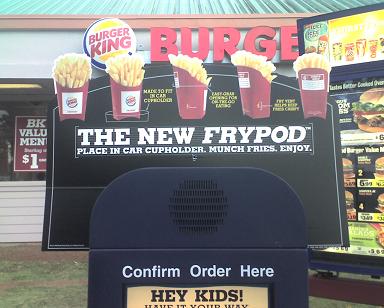
(Photo by Hawaii)
Other bloggers have wondered if Apple can sue Burger King for leeching off its cred — I'm guessing the answer is no. For my part, I'm just amazed at what seems like an excessive amount of promotion for a new shape of fry carton.
(Also, in 2007 the iPod is no longer the hip new thing: it's an institution. There's nothing fresh about the word frypod.)
As a Minnesotan, I found another ad far more irritating. The first sign in this set says "This burger is stocked full of good stuff." The second says "Just like our 10,000 lakes."
Our 10,000 lakes, Burger King? You are a corporation from Florida, worldwide maybe but not Minnesotan. Multinational fast food chains aren't local just because they're found locally. I feel like the King is sidling up to me in a bar, asking for a favor, all calling me buddy and pal.
Fierce is one of my fave Tyra words! She uses it on America's Next Top Model all the time -- I have no idea what it means but the models all seem to know exactly what to do. Secret language?
They must be working on some level we can't understand... that would also explain Tyra's ability to demonstrate what to do and what not to do with what sometimes look like identical gestures.
[snort] I think it has to do with the number of times she blinks.
ps: we got a nice mention on Mr. Verb today if you didn't see it yet.
Never mind the lakes, I'm not sure I'd want a burger that was 'stocked full' of anything. Just doesn't sound very appetising (like eating something that was 'assembled', or 'manufactured').
Oh, and the Mr Verb mention was a result of me pimping myself out for publicity...
And you're both welcome...
Thank you, JD, for our submentions to your mention :-)
Well-pimped J.D. — and we're complementary goods! I feel like one of those fancy condoms from Pretty Woman.
I like your point about "stocked full" — it is oddly artificial. I wonder if the other state-specific advertisements are as strained.

Redneck radar love
Monday, November 5, 2007 11:43 PM
My brother claims that the other speeders are supposed to be the rednecks here. If that's true, his formulation would be atypical of redneck terms, which usually refer to the crass or low-tech improvisations of purported rednecks.
I'd thought that the redneck limo was the most famous example of this formulation, but it seems that the beach along Florida's panhandle is well known as the Redneck Riviera.
I could google any number of redneck words and probably come up with results, but I can't think of any other terms off the top of my head — most Minnesotans would probably file our local "rednecks" under white trash, so it's not a word I hear very often.
Gnarly
Wednesday, October 17, 2007 10:57 AM
According to the Online Etymology Dictionary, the word gnarled initially appeared only in Shakespeare ("Merciful heaven! / Thou rather with thy sharp and sulphurous bolt / Split'st the unwedgeable and gnarled oak / Than the soft myrtle"), likely as a variant spelling of the earlier knarled.
Which is not quite obsolete nowadays. Editors could conceivably find themselves replacing an intentional use of the original spelling with what was once a non-standard spelling variant. Following common usage here is the obvious choice — too many people would think knarled was an error, not that language is a democracy oh-no — but if you care about "correctness" you should feel a bit conflicted. Along similar lines, I used to wonder what I would do if someone wrote curry Fauvel instead of curry favor.
(Obviously: remove the reference to an obscure poem from 1310. I'm here to represent the readers, after all.)
Both gnarled and knarled meant something like "knotty or misshapen."
So Shakespeare's gnarled goes unnoticed until the 19th century, when the poets of the day bring it back into currency. It's around that same time that people start using the backformation gnarl, meaning either "a protruding knot on a tree" or "to contort, twist."
A decade or so later they then make a new adjective, gnarly, out of that word. So gnarly goes back way back to 1829.
In the 1970s, surfers started using gnarly to describe dangerous waves (presumably they were quite twisty?), and by the 1980s it had been adopted into teen slang as a word for both "excellent" and "disgusting."
It's the "excellent" sense that seems to have won out. Although my guess is that, with the possible exception of some speakers on the West Coast, gnarly is used by most people today with at least a twist of irony.
(Bonus videogame tie-in: in Super Mario World, each level in the secret Special Zone took its name from surfer slang. In order: Gnarly, Tubular, Way Cool, Awesome, Groovy, Mondo, Outrageous, and Funky. It felt like I spent weeks trying to beat Tubular.)
Meat market lexicography
Saturday, October 13, 2007 2:38 PM
It surprises me that even while the list of English collective nouns for animals has expanded to include many, many dubious group names, our lexicon of meat words has hardly changed at all, not since the 11th century Norman occupation of England.
(Speaking of the Battle of Hastings, at what point in history did it become easier to become famous for what you did than for how you died? That he supposedly got shot in the eye is prettymuch the only thing I know about King Harold II. See also: the Catholic saints.)
During the Normans' extended visit, a number of high class Old French words (e.g. buef, Old French for cow) shimmied into our vocabulary, creating a lexical distinction between what was raised and what was eaten. Nearly a thousand years later, here's our active animal-meat lexicon:
calf: veal
cow: beef
deer, antelope, moose, caribou: venison
domesticated fowl: poultry
swine: pork
sheep: mutton
snail: escargot
squid: calamari
And occasionally:
kangaroo: astralus
shrimp: scampi
Besides astralus, only three of the terms on this list are recent additions. Escargot was (re)imported from French in the late 19th century, and while I don't have OED access, my guess is that the Italian calamari and scampi came along a bit later. The Online Etymology Dictionary dates scampi back to 1930.
In my experience calamari is almost always used instead of squid, while scampi only pops up in certain recipe names. I'd be remiss if I didn't also mention long pork, a culinary name for human flesh; it was supposedly coined by the cannibals of either Samoa or Fiji.
(The Wikipedia article on culinary names is fairly flabby, but it did point me towards two handy culinary euphemisms: Rocky mountain oysters for buffalo, boar, or bull testicles, and sweetbread for the thymus gland or pancreas of a young animal. And there's tripe, of course. Foie gras is used to describe duck and goose livers, but only when they've been artificially fattened by gavage.)
Perhaps this is because they weren't necessarily raised by anyone, but it strikes me as odd that English has no culinary names for squirrel and rabbit. We've been eating squirrel for a long time — my copy of The Joy of Cooking still has a squirrel recipe — but apparently the Anglo-Norman esquirel merely supplanted the Old English acweorna.
Stranger still, Old French gave us coney (and rabbit for young coney) to describe an animal similar to the one we called hare, and both names were able to exist side-by-side without either becoming a meat word — centuries later, early American colonists had a similar choice (rabbit vs. hare) and basically stopped using hare altogether.
(Somewhat related: Welsh rabbit, the world's tastiest ethnic slur. And rabbit fur is sometimes called by the euphemism lapin.)
More understandable is the lack of a culinary name for dog meat, which the Koreans call gaegogi.
(Not related: another fun meat-related word is jerky, an alteration — misspelling? — of charqui, itself apparently an English word borrowed from American Spanish.)
As any Good Eats fan knows, the word corn underwent a semantic narrowing. It used to refer to a number of kernels or seeds, or even just a bunch of coarse salt granules. So we call it corned beef in reference to the salt packed around the brisket.
The word meat is itself interesting for much the same reason: it once meant simply "food."
Hello folks,
FYI the dish is not called "Welsh rabbit" but "Welsh rarebit". Also, rabbit and hare are two distinct species (i.e. the rabbit is not a domesticated hare), the former being "Oryctolagus Cuniculus", the latter "Lepus" (Europaeus, Articus, Americanus, etc...).
Also, as synonym of "rabbit" in English, now out of use, is "coney" - compare with "conejo" (Spanish), "coniglio" (Italian), "coleho" (Portuguese).
Thanks for the tip about coney — I hadn't realized that was the probable origin of Coney Island. I'm still surprised that the Old English hare and Old French coney/rabbit didn't follow the standard meat/animal differentiation, but I've updated the entry to be less confusing, i.e. less wrong.
As the entry I linked to points out, and most modern sources will corroborate, Welsh rarebit (attested from 1785) is most likely a corruption of Welsh rabbit (1725). The former has gained currency today as the less offensive term.
Rachaelisms
Monday, October 8, 2007 1:25 PM
If you've never heard of Rachael Ray — a noteworthy achievement these days — she's the goofy, unabashedly unsophisticated host of several Food Network shows. As Slate notes, she's also quite possibly "the world's most reviled chef."
Since I myself have a mild case of Rachael Ray Derangement Syndrome (full disclosure: I heart A.B.), until yesterday I'd avoided her shows.
So I didn't know.
I'm here today to talk to you about Rachael Rayisms, or as they're more commonly known, Rachaelisms (alternate spelling: Rachael-isms). These are words and catchphrases either invented or frequently used by Rachael Ray.
The most famous Rachaelism is EVOO (an acronym for Extra Virgin Olive Oil, pronounced "e-voe"). As any professional linguist could tell you, this officially became a real word earlier this year, when it was included in the Oxford American College Dictionary.
Here's Ray accepting a certificate from Erin McKean, quite possibly the world's most beloved lexicographer.
It's actually pretty cool that such a well-known chef plays with language like Ray does, and I really have to respect her for not letting the haters ruin her fun. Coin on, Rachael Ray.
I just dislike the words she comes up with. In the episode we watched, she coined the word choup, a blend of chowder and soup. Then she proceeded to say "choup" about fifty times as she made what was (in my lexicon) clearly just soup. I'm sure that for some people, even chowder is just a kind of soup.
Your definitions, like Rachael's, may vary.
Some notable Rachaelisms
Choup - A blend of chowder and soup.
Delish - A clipping of "delicious."
Easy-peasy - Easy
EVOO - Extra Virgin Olive Oil
G.B. - Garbage Bowl
Igidator - Refrigerator
Motz - Mozzarella cheese
Sammie - Sandwich
Shimmy-shake - Toss (?)
Smashed potatoes - Potatoes that have been roughly mashed.
Spoonula - A blend of spoon and spatula.
Stoup - A blend of stew and soup.
Turn of the pan - A measurement used when drizzling a liquid, esp. EVOO, into the recipe. (Also, I swear I heard her use the measurement "a third of a palm." Apparently she's a big fan of eyeballing.)
Yum-O ! - Yummy, possibly very yummy.
Nunberg's "Punctuation"
Thursday, September 20, 2007 12:33 PM
Anyone who knows me shouldn't be too surprised to learn that it was the chapter's invention/use of a precise technical vocabulary to describe punctuation concepts that intrigued me the most. Below: some highlights.
Here's an early, crucial distinction between segmental and non-segmental punctuation.
The punctuation marks are all segmental units of writing — i.e. they fully occupy a position in the linear sequence of written symbols. There are, however, various non-segmental features which can serve the same kind of purpose as the punctuation marks. For example, titles of literary or other works may be italicised as an alternative to being enclosed in quotation marks.
Note that the Cambridge Grammar classes accents and umlauts as spelling, not punctuation — I don't have my own copy (yet), so I'm curious to see how they classify the New Yorker's use of diereses. That looks like non-segmental punctuation to me.
Before they get into the nitty-gritty of punctuation, the authors make a distinction between signifier and signified that would make Saussure proud:
In virtually all written material the apostrophe is physically — or, as we shall say, graphically — identical with a single quotation mark. We need, therefore, to distinguish between two kinds of concept which we will call indicators and characters. The characters are the graphical shapes, or symbols, that realise the indicators. Apostrophe and single quotation mark are then distinct indicators that may be realised by the same character.
In terms of specific punctuation, I enjoyed the lengthy discussion of How Commas Work, but it's much too long to quote here in any meaningful way.
However, there's a great part about the three types of hyphen.
At the first level we can distinguish three uses of the (ordinary) hyphen:i. To join grammatical components in complex words: the hard hyphen
ii. To mark a break within a word at the end of a line: the soft hyphen
iii. To represent in direct speech either stuttering ('When c-c-can I come?') or exaggeratedly slow and careful pronunciation ('Speak c-l-e-a-r-l-y!')
The terms 'hard' and 'soft' are taken from word-processing: a hard hyphen is introduced into a document by a keystroke, while a soft one is inserted by the word-processing program.
Why — why? — did they not name that third hyphen type? The English geekery gods can be so cruel.
There's also a section on the en dash, which they call the long hyphen. I keep promising myself that I'll start using this consistently, but it's clearly the forgotten punctuation mark:
This is used instead of an ordinary syntactic hyphen with adjuncts consisting of nouns or proper names where the semantic relation is "between X and Y" or "from X to Y":
[...]
It can be used with more than two components, as in the London–Paris–Bonn axis. It is also found with adjectives derived from proper names: French–German relations. There is potentially a semantic contrast between the two hyphens, as in the Llewelyn–Jones Company (a partnership) vs the Llewelyn-Jones Company (with a single compound proper name). This hyphen is also used in giving spans of page numbers, dates or the like: pages 23–64, Franz Schubert (1797–1828).
Finally, there's a brief hat-tip to the separation apostrophe. This indicator category presumably includes the common-but-nonstandard greengrocer's apostrophe, but their examples mention only the form I've taken to calling the special-assignment plural apostrophe-S, the style choice that launched a thousand incorrections:
iii. separation: A's PhD's if's 1960's
A minor use of the apostrophe is to separate the plural suffix from the base, as in [7iii]; this occurs when the base consists of a letter (She got three A's in philosophy), certain kinds of abbreviation, a word used metalinguistically, or a numeral.
This book would probably be the perfect accompaniment to the $13 Merriam-Webster's Concise Dictionary of English Usage (also on my Amazon wish list) if it weren't so definitively out of my price range.
Labels: links, punctuation, vocab
fyi but you probly know this: the special-assignment plural apostrophe-S is called standard by the Oxford Companion to the English Language.
I'm woefully short of dead tree reference materials, but I'm not too surprised.
It seems like at least some version of this apostrophe should be standard for everyone, and that the people who get upset by it wouldn't if they would just stop and think about it...
Donkeys and ponies
Friday, September 7, 2007 10:25 AM
(I say either one-point-seven-five or handle — yes, yes, even when there's no handle. Some people apparently say jug.)
Does anyone else say donkey? The Double-Tongued Word Wrestler came up blank, and all I learned from the Urban Dictionary was how disgusting the Internet is. However, after much too much googling, I found a single (apparent) corroboration on a message board:
but remember, no party is the same without me. NEVAR!~~
new years party, Im bringing a donkey bottle of cuervo. [cite]
The other commenters seem to be from the Houston area, which only deepens the mystery.
I had more luck with pony, which my mom used this past weekend to describe those stubby little bottles of beer. (Not to be confused with pony keg, which was my initial interpretation. Now that would have been a much more interesting story.)
Foodgoat has a great roundup of the many alcohol-related meanings of pony.
This sense of the term apparently comes from the old 7 oz. Rolling Rock bottles, which had a picture of a pony on the label:
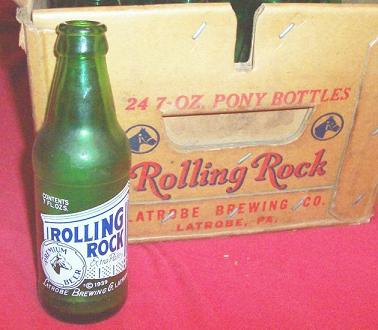
There are many imitators, and as far as I can tell no brewery, Rolling Rock included, is too keen to take the credit for inventing the pony bottle.
Incidentally, Rolling Rock is also somewhat famous for printing a mysterious 33 on the bottles. I'm reminded of the similarly mysterious journalistic 30.
Big Fish
Tuesday, September 4, 2007 12:48 PM
I don't fish very often at all, but my brother fishes constantly and is by all accounts an expert. His unselfconscious use of U.S. fisherman's slang is fascinating. Did you know that the American fishermen have over 500 words for lure?
Two words stood out. When my mom caught a large sunfish, my brother said, "Wow, that's a toad." An In-Fisherman search confirms that while this isn't too common in print, he's not the only one to use the term:
The toad jumped out of the water and thrashed back and forth, trying to throw the lure. Then my pole bent almost double as the brute raced into the thick submerged vegetation and broke off. [cite]
For obvious reasons, fishermen seem to have a lot of synonyms for big. My brother later referred to a walleye as a horse (and not a toad, because the body shape is different). Here's another example:
Of all the places to make that first cast at 12:01 a.m. on opening day, the shallow humps west of Kunz Island on Washburn County's Long Lake may be the best place to tie into a real horse in Wisconsin's northcountry. [cite]
There's also another, far more common sense of horse that isn't restricted to fishermen, but was new to me: "To haul or hoist energetically."
With mono line, chances are you aren't going to be able to horse the fish out of the weeds and tules. [cite]
(Imagine the opportunities for journalists covering fishing contests! "Dark horse horses horse!" And this when his boat only had a 10-horse engine.)
I'm probably too used to hearing fishermen speak fishermen-speak, but it seems to me that the vocabulary here isn't quite like the jargon of other specialist groups.
There are still plenty of specialist terms, of course, but since these people are enthusiasts and storytellers, there's also an amorphous secondary lexicon, concerned with variety instead of precision.
I'd love to read a good essay on U.S. fisherman slang, if anyone has found one. In the meantime, there's also my post on the plurals of Minnesota fish.
(I was skunked, by the way: some bites but nothing in the boat. In my dialect this fishing-related sense is always passivized and intransitive.)
On Onboarding
Monday, August 13, 2007 8:29 AM
If you found this page with a query like "Is onboarding a word?" then yes, Virginia, it's a word. The earliest cite I could find was a July 1995 "personal communication" quoted in Joseph Donald Novak's 1998 book Learning, Creating, and Using Knowledge: "I think this would have a real value for onboarding new hires."
But what is onboarding? According to Random Wikipedia Guy:
Onboarding is the process of interviewing, hiring, orienting and successfully integrating new hires into the organization's culture.
Though I suspect that the definition at Systematic HR is closer to the mark:
So what is onboarding? First of all, it's one of these annoying buzz words we have in HR these days. It is an important one though, and the practice has initiated all sorts of new tactics for recruiting and retention. Onboarding is the process of integrating employees into their new work environment.
I appreciate the candor, in any case. The important difference between onboarding and other terms like hiring and orientation seems to be that it covers a longer part of the process. Look what I find when I cast my net out into the Googlesphere:
Timing: In my opinion, onboarding begins with the offer letter.
Onboarding begins before the first contact with a candidate and evolves through the five stages leading up to and following the first contact, offer, acceptance and start day.
Actually, onboarding can begin as early as during recruitment by giving clear expectations of the job.
Onboarding begins with the first interview and will continue long after the 1 or 2 day induction.
Onboarding begins the moment the candidate first connects. with the company.
Onboarding begins with the recruitment process,. which is the employee's first interaction with the firm.
However fascinated I am by corporate-speak, I'm not so much appreciating a piece of fine art as I am poking a squishy black thing with a stick. I note with some trepidation that you can also onboard someone.
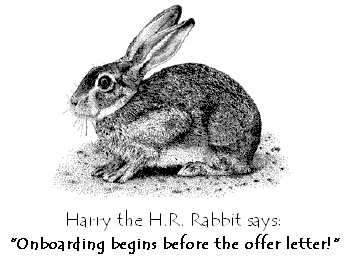
Well, that's all for me. What's today's corporate-speak lesson, Harry?
Josie and the Usage Quirks
Saturday, August 11, 2007 2:21 PM
If you've never heard of Josie and the Pussycats, the movie is a satire of consumerism, complete with ubiquitous unpaid product placement throughout. There's also some language-related goodness.
X is the new Y
To parody faddishness, the movie makes extensive use of the snowclone "X is the new Y," as you can see in the examples below:
Pink is the new red!
Orange is the new pink!
Blue is the new orange!
Feathers are the new rhinestones!
Tretorns are the new Adidas!
Gatorade is the new Snapple!
Josie and the Pussycats are the new Du Jour!
Diet Coke is the new Pepsi One!
Heath Ledger is the new Matt Damon!
Alan M.
I know nothing of the Archie Comics universe, but I couldn't see Alan M. without wondering what, if anything, the M stands for. As one character observes, "Yes, what's with the initial anyway? It didn't work for Sheila E., and it doesn't work for you." One fan site unhelpfully notes that
Although for many years the "M" in his name was a mystery, Archie Comics now gives his name as Alan M. Mayberry.
But that doesn't settle anything; it just makes us wonder which initial Alan is using. In the meantime, we're left with a lesser version of the Harry S Truman vs. Harry S. Truman debate. Is it properly Alan M Mayberry or Alan M. Mayberry? I'd personally go with the latter: the period should only be omitted when we know it's not an abbreviation.
Jerkin'
Lastly, the movie coins its own word for cool, and uses it pretty faithfully. When a character later says cool instead, she's accentuating an important plot point. Here's the coinage:
Woman 1: "The new word for cool will be jerkin', as in 'Dude, that's jerkin'!'"
Woman 2: "Ooo, that's dirty."
The Perils of Contronymity
Monday, July 2, 2007 10:47 PM
Which is to say: everyone I have ever met uses factoid to mean "a brief, somewhat interesting fact." I was quite surprised to read that this is the newer, less-preferred usage. American Heritage notes that:
Similarly, factoid originally referred to a piece of information that has the appearance of being reliable or accurate, as from being repeated so often that people assume it is true. The word still has this meaning in standard usage. Seventy-three percent of the Usage Panel accepts it in the sentence It would be easy to condemn the book as a concession to the television age, as a McLuhanish melange of pictures and factoids which give the illusion of learning without the substance.
However, I'm so used to the newer meaning that I initially read even this example that way.
I can see why Read Roger is so upset by the contradictory definitions here: at least with unpacked, another contronym, you can nearly always figure out the meaning from the context.
That said, I'm fairly certain that my definition will prevail; it's the intervening confusion that's the problem.
p.s. A comment at Read Roger reminded me that I probably picked up my preferred meaning of factoid from the Simpsons episode "Homer Defined," wherein Homer's name becomes a contronym of sorts. In the first scene, Lisa refers to a USA Today-style newspaper as "a flimsy hodgepodge of pie graphs, factoids, and Larry King."
On the utility of notecards
Friday, June 22, 2007 1:01 AM
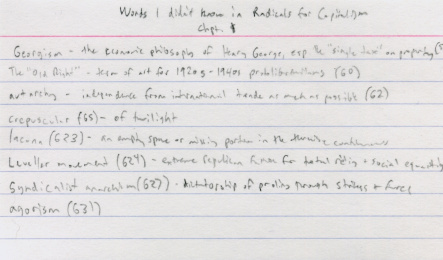
Probably you've done this too. Eventually I started doing the same thing with books written in English. Here's an example from 2004:
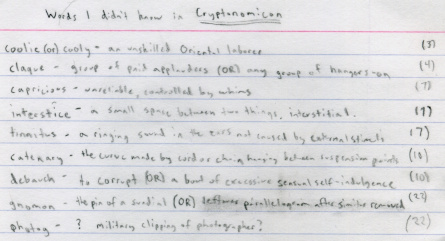
I found a whole pile of these in a recipe box a few days ago, and there are probably more than a few finished notecards still inside their books.
I've started doing this again because — well, I'd like to think that the utility of this approach would be obvious. You get a useful bookmark, you don't have to break the flow of the story to go look something up, you have an easier time learning and remembering the new words, and later you can use the page number to review the words in their original context.
So the vocab-building (and chickenscratch) continues:
Labels: vocab
One Fish, Two Fish
Monday, June 4, 2007 9:56 AM
(I always use the phrase "avid fisherman" to describe my brother. A few years ago I was mildly obsessed with finding simple descriptive phrases for everyone I knew: it's nice to have a two-second personality summary on hand when you're telling a story.)
My curiosity had been piqued by a show on piranhas, but being from Minnesota, I kept thinking about our native fish.
First, a note on plurals. As Arnold Zwicky points out, English has singular count nouns (an egg), singular mass nouns (the bread, the rice), and plural count nouns (the eggs).
Fish lexemes have access to all of these forms, and if you're referring to a fish type within the scientific classification system there is an additional plural (technically, it's probably a different lexeme) that is apparently always formed by adding -s or -es. In my dialect, this is the only time you'll hear basses.
(Other people will have different versions of these forms, due to their crazy correctness conditions. For example, Californian fisherman Jed Welsch writes in the L.A. Press Telegram: "Those aboard The Big Game caught eight yellowtails and 100 calico basses.")
Here are the rules for Minnesotan fish: the singular count and mass forms of fish lexemes are always identical: I caught a bluegill, would you like some sunny, let's go fishing for crappie, etc. Likewise, most of the plurals of Minnesotan fish are straightforward: add an -s or -es.
The American Fisheries Society styleguide matches my choices on this topic. Except for minnow. We say minnows. But the AFS styleguide notwithstanding, I don't know who wouldn't.
What's really interesting is that, even where we use the uninflected version of the original fish name, Minnesotans' plural formation tends towards the standard method, to the point of creating new words. The lexeme pike is uninflected in the plural, so we took Northern pike and made northerns. Muskellunge was also uninflected, but we call them muskies. In my experience both of the standard pluralization forms are highly preferred.
C.f. jumbos for jumbo perch, rainbows for rainbow trout, and smallmouths and largemouths for the two major sport varieties of bass. Only carp seems to have no access to a standard plural form, but as it's generally considered neither a sport fish nor bait, carp occurs at a much lower frequency than these others.
I'm also amused by the widespread usage of wally/wallys (or walleys/walleys) for walleye/walleyes. This plural is pretty flexible: I think most of us would have no problem — certainly no WTF problem — with I caught three walleye. I think I say walleyes, but many Minnesotans don't inflect the plural unless they're using the jocular version of the name.
Yarrrg, you scurvy Kripke
Friday, May 25, 2007 10:24 AM
1. The decaying carcass of a giant sea creature (presumably the Kraken from the previous movie) was washed up on a beach. This reminded me of a word I'd just learned a few hours earlier:
globster — a large, beached, unidentified organic mass presumed to be some sort of dead creature.
2. The use of king as a gender-neutral term. I thought this usage was novel but unproblematic: the characters were looking for someone to be the "pirate king" and since the title was unalterable and the election process (or is it elections process?) was gender-neutral, a woman could end up as king. A "pirate queen" would have been useless.
I'd wager that some people in the audience didn't even bat an eye at the movie's use of king. Is the ability of a title to describe someone who would be excluded if we took that title literally another victory for the descriptive theory of names?
I vaguely recall learning about a real-life English queen who quelled doubts about her ability to rule with rhetoric that established the part of her that was ruling as male, but even if she could have said that outright then, she couldn't now. For the vast majority of English speakers king always denotes a non-female.
(Notice that I didn't say "denotes a male" — in some alternate universe I could imagine a "King Robot" or a "King Turnip" where the use of king is not metaphorical.)
Labels: vocab
I wondered about this when Sheryl Crow sang the line, "I'm still the king of me" in Soak Up the Sun.
The Hobbitification of America
Wednesday, May 9, 2007 10:03 AM
From a language perspective, we're a little bit richer because we have this word, just as we're richer for having Taco Hell.
(Contrast this useful addition to the language with McDonalds' attempts to enforce their narrow corporate usage of the Mc prefix.)
Basically, this is another word for what is already known as the midnight snack. In my idiolect, and doubtless for others as well, the midnight snack doesn't have to be at midnight and can be far bigger than a mere snack. I know this one Taco Bell fan...
I'm a bit surprised that most of the articles on fourthmeal don't use the term. There are, of course, some interesting and useful connotative differences.
More shocking is the claim (I humbly submit that the Language Log people might call it Whorfian) that the word itself will encourage people to have four meals:
Still, the article did include this gem of a quote from Taco Bell spokesperson Rob Poetsch:
Taco Bell counters that Fourthmeal isn't intended as a literal suggestion. "We're not encouraging people to eat four meals," Poetsch said.
"Freedom is slavery," he did not go on to say. "Ignorance is strength."
Maybe the marketing campaign to which the word is attached is trying to do that, but merely having a word for something should not influence behavior.
Moreover, our language already has several, if not widely-used, than at least more widely-known words for extra meals. Tolkein played on this by giving hobbits an extra large vocabulary to describe meals. According the Wikipedia, hobbits recognize breakfast, second breakfast, elevenses, luncheon, tea, dinner, and supper.
I seriously doubt that Tolkein coined any of these words; instead, he merely narrowed the usages of a few words whose definitions often overlap.
The fact that we can instantly understand all of these terms, just as we understand fourthmeal, would seem to indicate that we've had the concepts all along.
Labels: vocab
And stoves will be called "kenmores"
Thursday, April 26, 2007 4:04 PM
(Aside: I've heard the such as vs. like distinction before, and have occasionally copy-edited for it rather than risk even that slight confusion. But I think it's a stylistic trade-off because such as probably sounds stilted to most people of my generation. We are Generation Like.)
For those of you not familiar with elimination-style reality shows, there's often a first challenge (usually for an award) followed by a second, more important challenge (for either a bigger reward or to avoid elimination).
On Top Chef, that first challenge is called the quickfire challenge. I had some problems with Top Chef (i.e. I couldn't taste the food), but quickfire challenge has always struck me as an unusually evocative phrase.
Recently I've noticed that like some of my friends, I've started applying that term unselfconsciously to the first challenge on any reality show. A quick web search confirms that we are not alone in this.
Over at Nerd World, the semantic broadening continues:
Quickfire challenge: what 5 things should the new Hulk movie do differently from the old Hulk movie?
Lev is not the only person doing this. The amazing thing is that even if you miss the allusion — he made it clear with a link, but others don't — this reference is probably perfectly intelligible.
I'd like to think that quickfire challenge has legs. Go neologism, go!
Trucker slang
Tuesday, April 17, 2007 6:34 PM
So here's the good stuff. Spelling has been corrected and censored epithets have been restored.
4-wheeler - "what we call any vehicle not a truck" (3)
albino deer - "a slang term we use to refer to the odd shit you see at night when driving too damn tired" (2)
bear - law enforcement officer (1)
bear in the air - police helicopter (3)
chicken hauler - trucks that are decorated heavily with chicken lights. (2)
chicken lights - The extra lights popular amongst owner-operators, lease-ops, and small companies looking to get noticed. (2)
city titty - local cop (3)
commercial - polite term for a prostitute (2)
convention - lots of city police (3)
county mounty - county cop (3)
customer - someone who has been pulled over. a cop is said to be "with a customer" if he currently has someone pulled over and "open for business" while manning a speed trap. (3)
discos - metonym for a cop with his submission lights turned on. (3)
dry van - a standard trailer (1)
floating - "floating involves shifting without ever touching the clutch except to stop or start out, and is DEFINITELY more art than science." (1)
full growed - "full growed = full grown bear = Sheriff" (3)
good buddy - "Good buddy is a slang term for gay truck driver by the way, so don't call a truck driver a good buddy unless you want punched. Call us simply 'Driver'" (2)
granny lane - the far right lane (3)
hammer lane - the far left lane (3)
lot lizard - slang for prostitute (1)
lumper - "'Lumpers' are one of trucking's dirtiest little secrets. They are people whose only job is to unload trucks. They are often part of a subcontractor group that functions independent of whatever facility you are delivering at and are most commonly found at food warehouses." (2) He claims later that this is an official term (3).
pickle park - a rest stop, called a pickle park "because the parking situation is usually so tight." (3)
picnic - lots of state police (3)
the push - a tactic where "we intentionally tailgate you (usually with headlights engaged, even if it's daytime) because you're driving like grandma and we want you to speed the fuck up or get out of our way." (3)
reefer - refrigerated cargo, usually food (1)
rolling - moving, driving (3)
the wiggle - a tactic in which "we pretend to 'accidentally' swing our trailer into your lane, scaring the shit out of you and making you get far away from us." (3)
Trucker slang is plentiful elsewhere on the internet as well: check out a longer list of terms at The Truckers Place.
Labels: vocab
Weekend language-related geekiness
Monday, April 16, 2007 8:32 PM
(The process by which shoots grow from a stump or the base of a plant — something all of us have seen before — is known as suckering.)
Also this weekend, I had to teach someone the distinction between immoral and amoral.
The blowback from semantic confusion sucks. Put John Q. Poindexter on a T-shirt saying that, and I'd buy it.
Common Errors in English is brief on the amoral/immoral distinction:
"Amoral" is a rather technical word meaning "unrelated to morality." When you mean to denounce someone's behavior, call it "immoral."
For my part, I've been using the The Columbia Guide to Standard American English distinction:
Amoral (the first syllable rhymes with day), means "above, beyond, or apart from moral consideration," and "neither moral nor immoral." Immoral means "not in conformity with the moral code of behavior, not moral."
Because I'm for the most part an idealistic shoot-self-in-foot deontologist, I'd be offended if someone seriously called me amoral. And although I've applied the term jocularly to some of my more consequentialist friends, there are apparently enough people out there confused by the difference between immoral and amoral, or unaware that there is any difference, that both words are probably best avoided when you're not upbraiding someone.
Unless you want to do some preaching on the behalf of your personal definitions, as I did above.
For those of us crafting Standard Edited English (American), outside of quotes and editorials, I'd apply the same standard to amoral that the AP recommends for fundamentalist (under "religious affiliations"): don't use the word unless a group applies the word to itself.
Nine times out of ten, you can/should probably recast the sentence with the non-offensive secular, which (for most people, I would guess) implies a lack of religious orientation rather than the absence of moral considerations.
Think reactive, not reactionary